
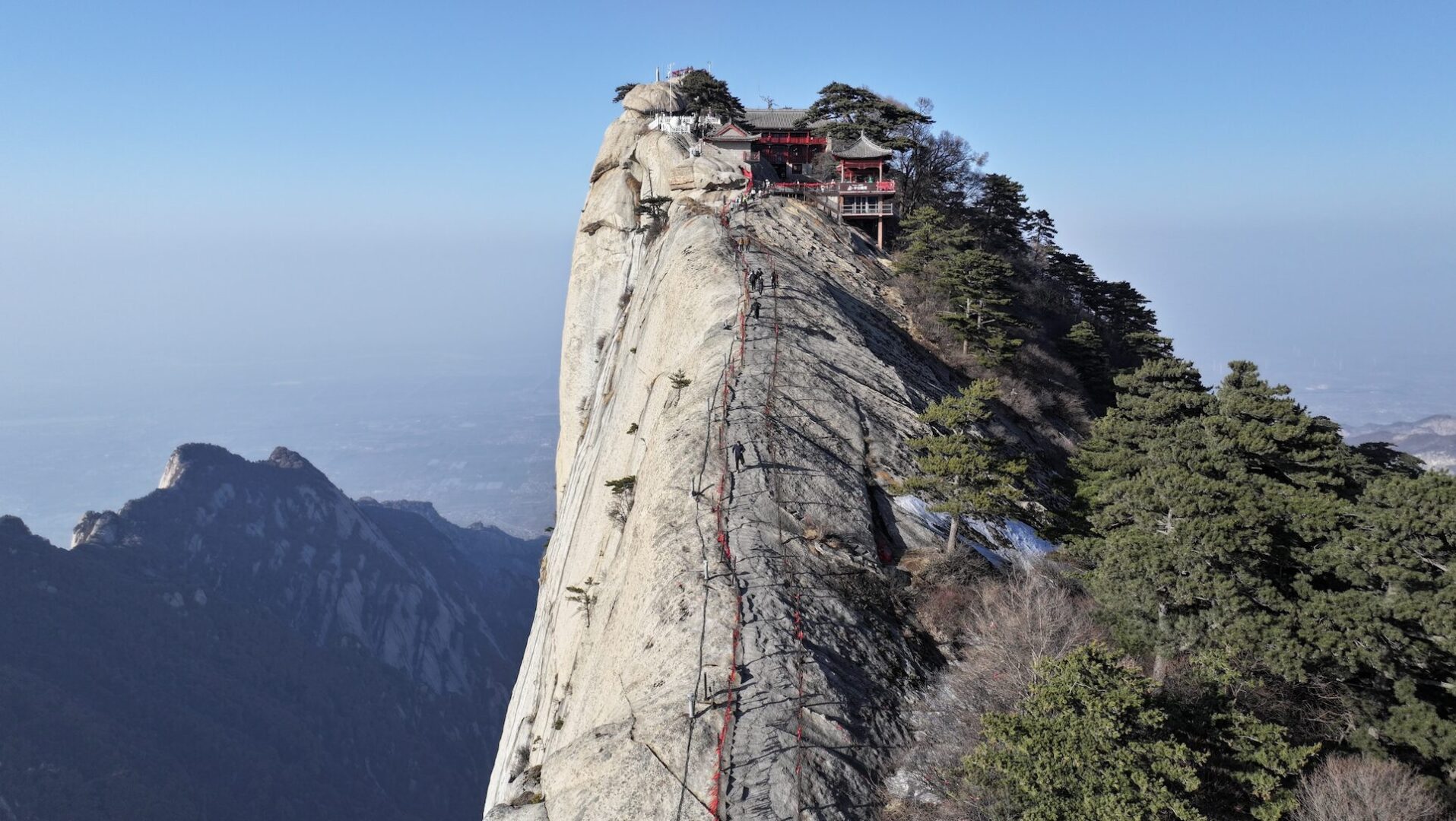
Huashan is one of China's five sacred mountains, and it has the most alarming walkway in the country — planks bolted to a cliff face with a chain to hold. The rest of it is steps.
Huashan rises out of the flat Wei river plain east of Xi’an as a granite massif with almost no foothills — which is why it looks the way it does, and why it has been one of China’s Five Great Mountains for something over two thousand years.
It’s the western one, and the Taoist one: temples on ledges, inscriptions cut into the rock, and a tradition of hermits and alchemists that runs from before the Han dynasty.
Its modern reputation, however, rests on a walkway.
The plank walk
Changkong Zhandao (长空栈道) — the “plank road in the sky” — is a line of timber planks, roughly 30 cm wide, bolted into a vertical cliff face below the South Peak, with a chain along the rock to hold and a drop of several hundred metres below.
You clip into a harness now, which is recent. For most of its history you didn’t. It leads to a small cliff shrine where a Taoist recluse is said to have lived.
It’s an optional side route, separately ticketed, and it is genuinely not for anybody with a fear of heights. It is also, if you can face it, the most extraordinary twenty minutes on any Chinese mountain.
The Chess Pavilion route below it is a similar proposition — steel rungs and a chain down and across a rock rib to a pinnacle with a stone chess table on it.
The five peaks
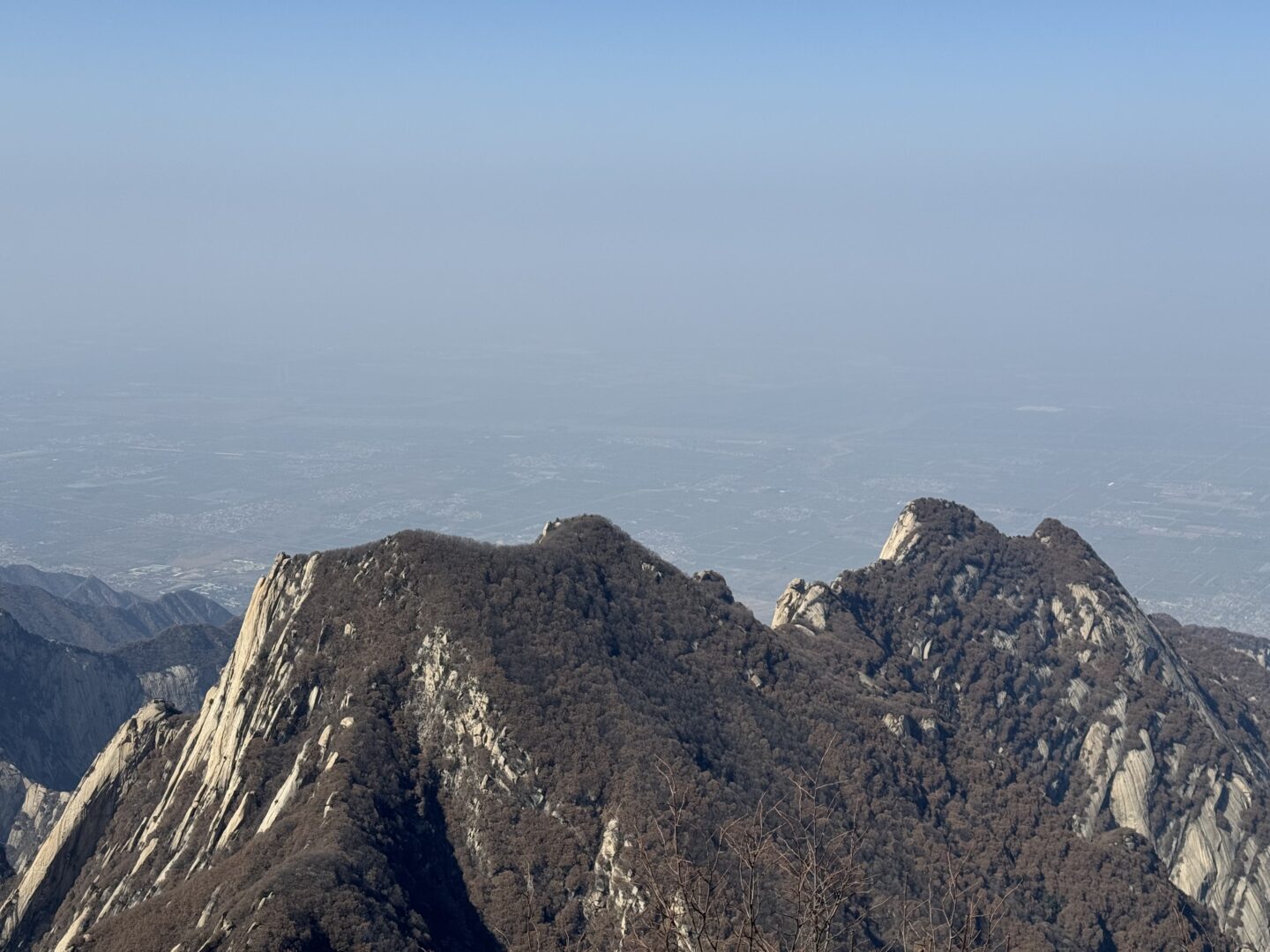
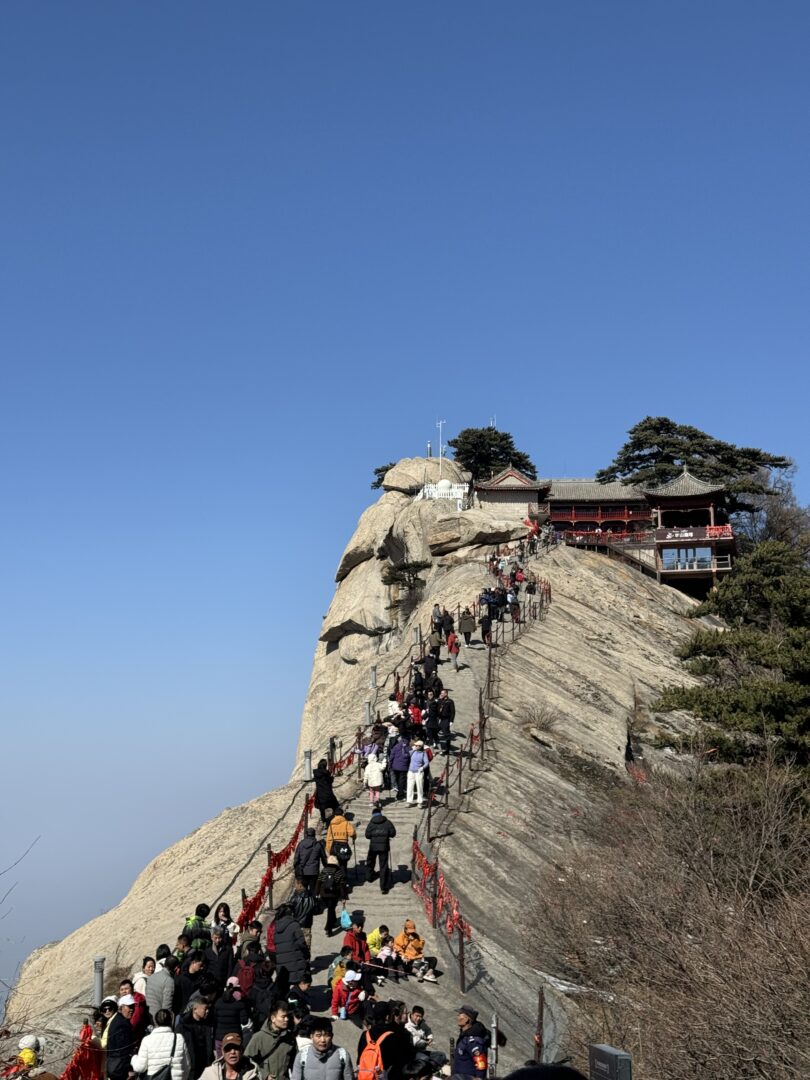
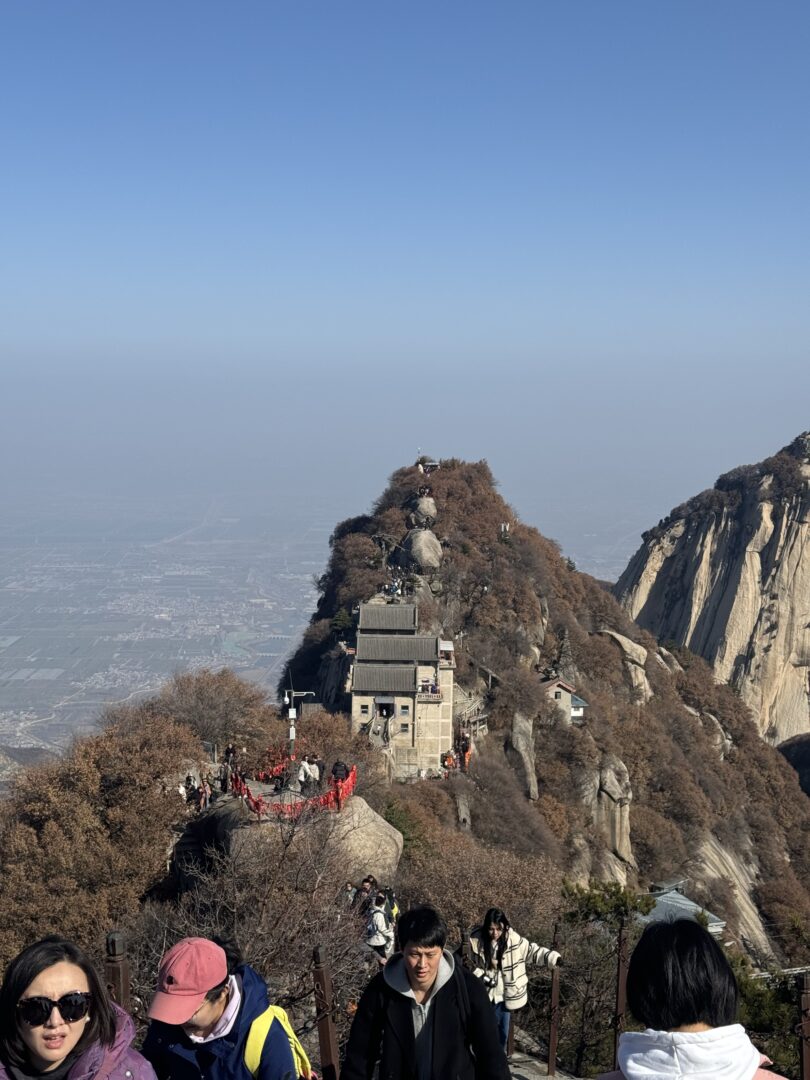
South Peak (2,154 m) is the highest, and where the plank walk starts. East Peak is the sunrise viewpoint — people stay overnight for it. West Peak is the most photogenic, a great sloping blade of granite, and has its own cable car. North Peak is the lowest and the main cable-car arrival point. Central Peak connects them.
The circuit between them takes most of a day at a reasonable pace, on steps and ridge paths with chain handrails.
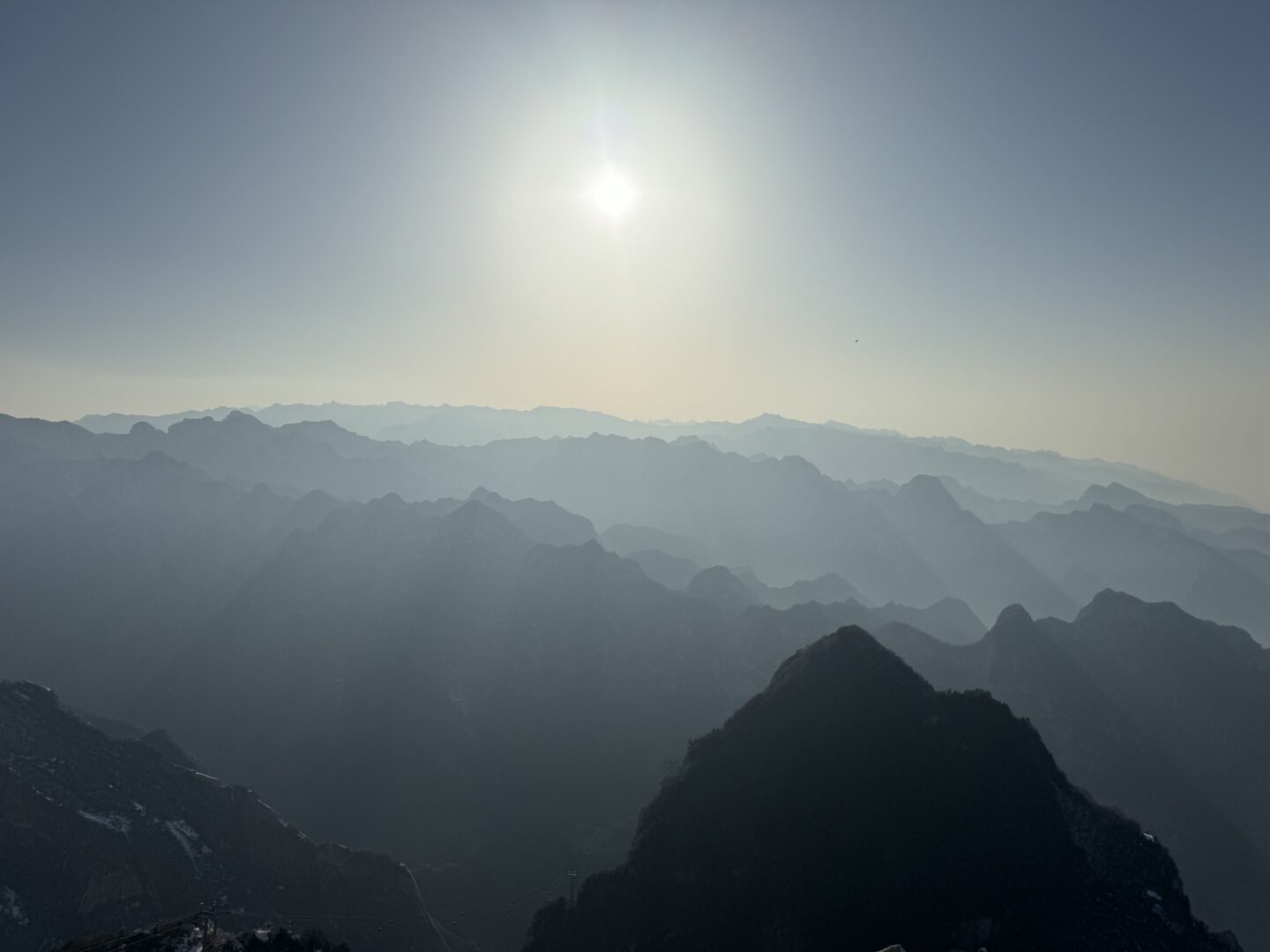
Huashan’s South Peak
Getting up
Cable car, two options. The North Peak line is shorter; the West Peak line is much longer, spectacular in its own right, and drops you higher up.
On foot from the base — the traditional route through the Huashan gorge to North Peak. Around four hours of continuous stairs, thousands of them, and it is a genuine effort. Worth it if you want to arrive the way pilgrims did.
The Soldier’s Path (智取华山路) — a steeper, more direct historic route, named for a 1949 military action. Harder and quieter.
Overnight — there are basic guesthouses near the peaks. Cold, expensive, and the only way to be on East Peak for sunrise.
Practical notes
Getting there: high-speed rail from Xi’an to Huashan North takes about 30 minutes, then a shuttle to the base. Very easy as a day trip, better as an overnight.
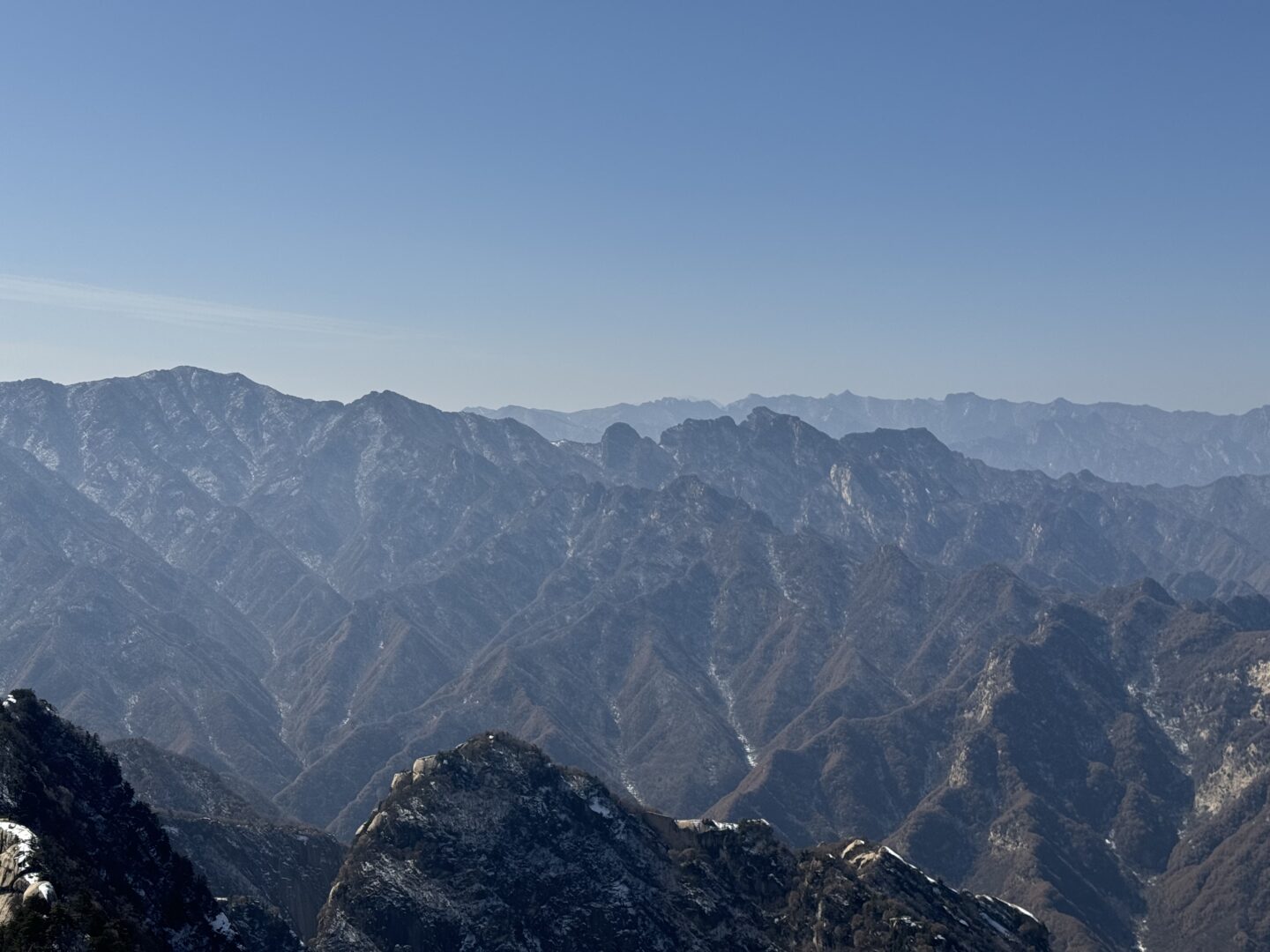
When: April to June, September to October. Winter is spectacular under snow and some routes close. Summer is hot at the base and busy everywhere.
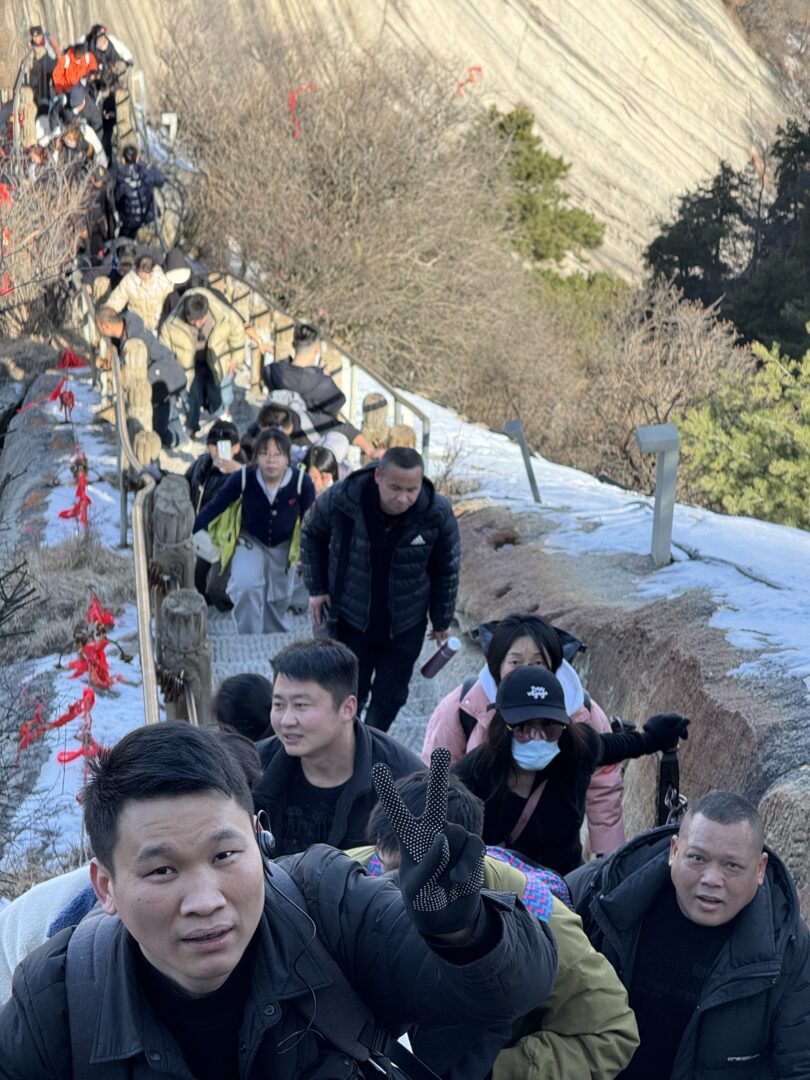
Avoid national holidays. The stairs and the chain sections become one-way queues, and on the plank walk that is not a comfortable place to be stationary.
Bring: gloves (the chains are cold and rough), a torch for a pre-dawn start, layers — the summit is much colder than the plain — and shoes with grip.
Safety: the exposed sections are properly harnessed now and staffed. Take the harness, use it, and don’t attempt the plank walk in rain.
Nearby: Xi’an is 30 minutes away by train, which makes this the easiest sacred mountain in China to reach.
- #shaanxi
- #huashan
- #hiking
- #taoism
- #plank walk