
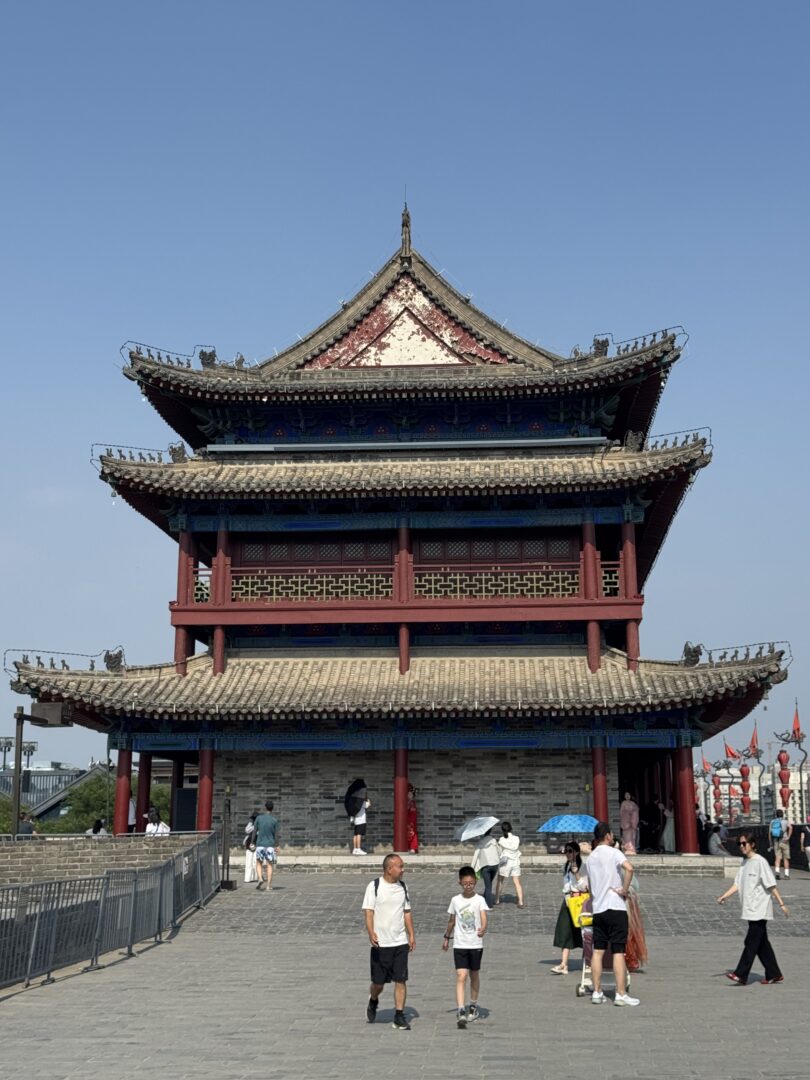
Xi'an was Chang'an, capital of the Tang and the eastern end of the Silk Road — for a while the largest city on earth. The walls, the pagodas and the Muslim Quarter are all still here.
Xi’an was Chang’an, and Chang’an was the capital of thirteen dynasties, including the Zhou, Qin, Han and Tang. At its Tang-dynasty height in the 8th century it was, by most estimates, the largest city in the world — a planned grid of a million-plus people, with foreign quarters, and a court that received embassies from Persia, India, Japan and Byzantium.
It was also the eastern terminus of the Silk Road. Everything that went west — silk, tea, paper, porcelain, and the technologies attached to them — left from here, through the Hexi Corridor toward Dunhuang and beyond. Everything that came east arrived here too, including Buddhism.
The Terracotta Army
An hour outside the city, and one of the genuinely unmissable sites on earth.
Over 8,000 life-sized figures — infantry, archers, cavalry, charioteers, horses — buried around 210 BC to guard the tomb of Qin Shi Huang, the first emperor. Every face is individually modelled. They were painted, though almost all the pigment has gone.
They were found in 1974 by farmers digging a well. Excavation continues; the emperor’s tomb mound itself has never been opened.
Practical: go early or late to avoid the worst crowding, do Pit 1 last rather than first (it’s the big one and everything after it is an anticlimax), and pay for a guide or an audio guide — without context it’s a lot of statues.
In the city
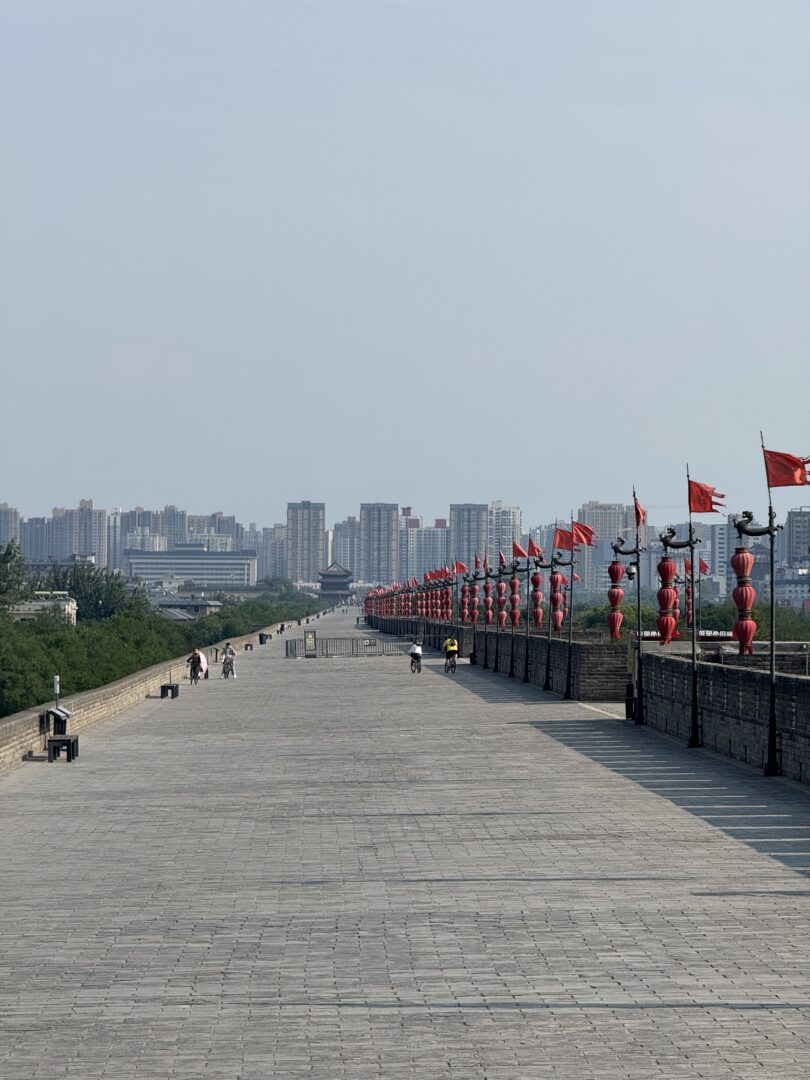
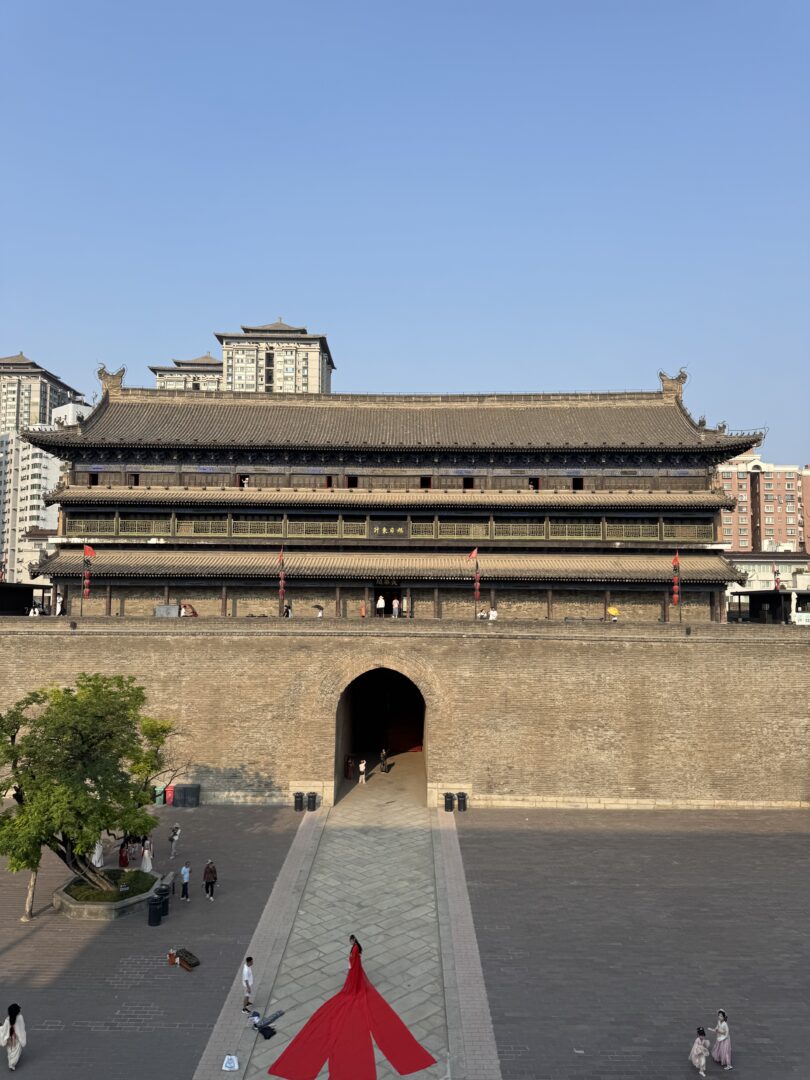
The city walls. Ming-dynasty, 14 kilometres around, complete, and 12 metres wide on top. Hire a bicycle and ride the full circuit — this is the single best two hours in Xi’an, and it gives you the shape of the old city.
The Big Wild Goose Pagoda. Built in 652 to house the sutras that the monk Xuanzang brought back from a seventeen-year journey to India — the historical basis for Journey to the West. Seven storeys of Tang brickwork.
Shaanxi History Museum. Genuinely first-rate, and the best place in China to understand the Tang. Book ahead; entry is quota-limited.
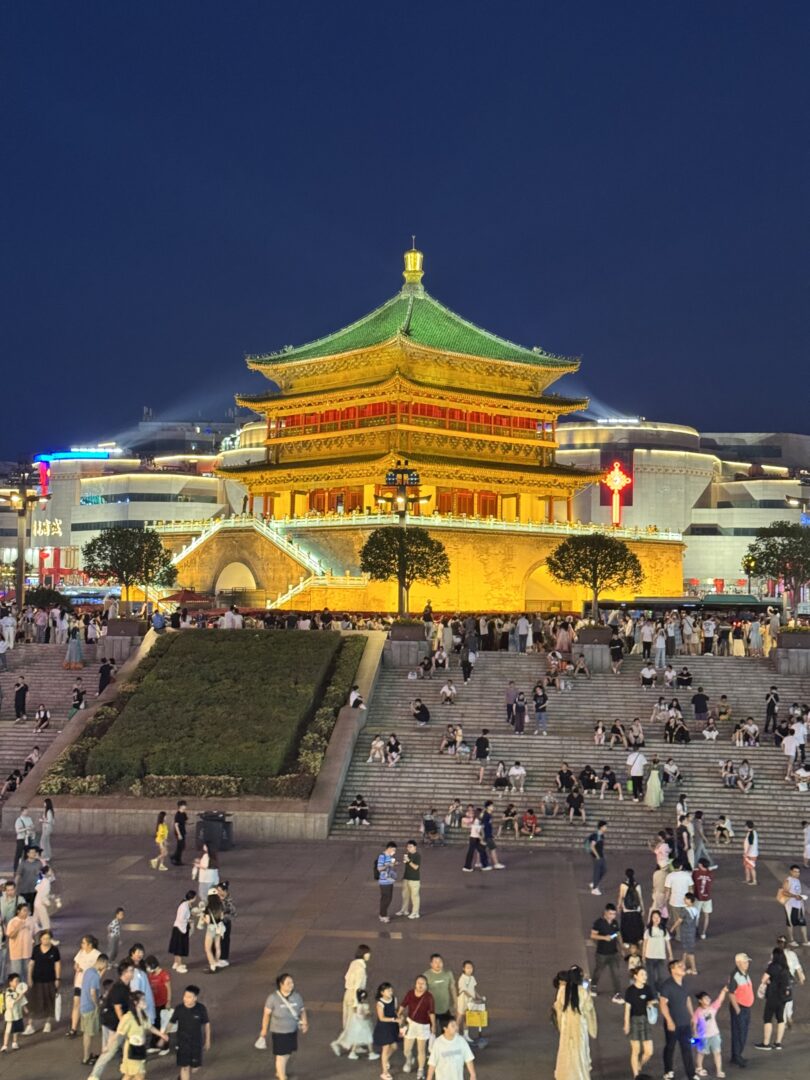
The Bell Tower and Drum Tower, at the centre of the grid.
The Great Mosque, in the Muslim Quarter — a Tang foundation, rebuilt over centuries, and built entirely in Chinese architectural idiom: courtyards, timber halls, a pagoda-form minaret. One of the most interesting religious buildings in the country.
The Bell Tower, at the centre of the old grid
The food
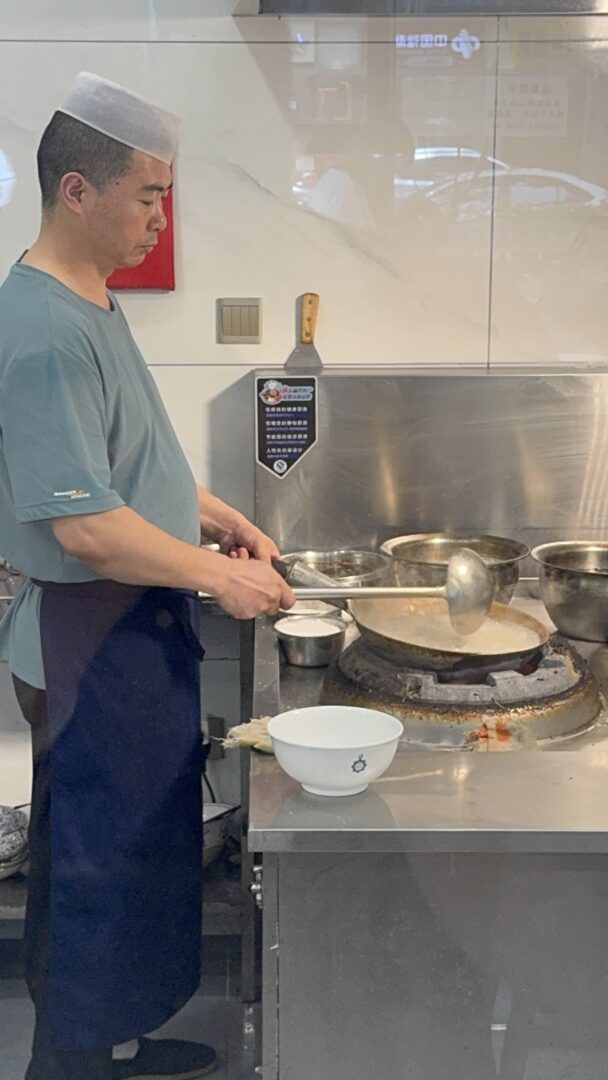
Xi’an is, by a defensible argument, the best street-food city in China. The Muslim Quarter is the concentration, and the Hui community here has been running it for over a thousand years.
- Roujiamo (肉夹馍) — braised meat in a flatbread. The original burger, and it predates the alternatives by about two millennia.
- Biangbiang noodles (油泼扯面) — belt-wide hand-torn noodles under scalding chilli oil
- Yangrou paomo (羊肉泡馍) — you tear your own flatbread into a bowl and lamb soup is poured over it. The tearing is part of the meal and takes ten minutes.
- Liangpi (凉皮) — cold wheat-starch noodles with sesame and vinegar
- Persimmon cakes, pomegranate juice, and skewers over charcoal
Go hungry, eat at six places, and don’t sit down at any of them. See our food guide.
Practical notes
Getting there: Xianyang international airport, and a national high-speed rail hub — Beijing in four and a half hours, Chengdu in three.
When: April to May and September to October. Xi’an summers are hot and it’s one of the country’s dustier cities in spring; see when to visit.
Onward: west along the old route — Guyuan and the loess plateau, Zhongwei, then the Hexi Corridor to Dunhuang and into Xinjiang. Or two hours east to Huashan.
- #shaanxi
- #xian
- #silk road
- #terracotta army
- #food