
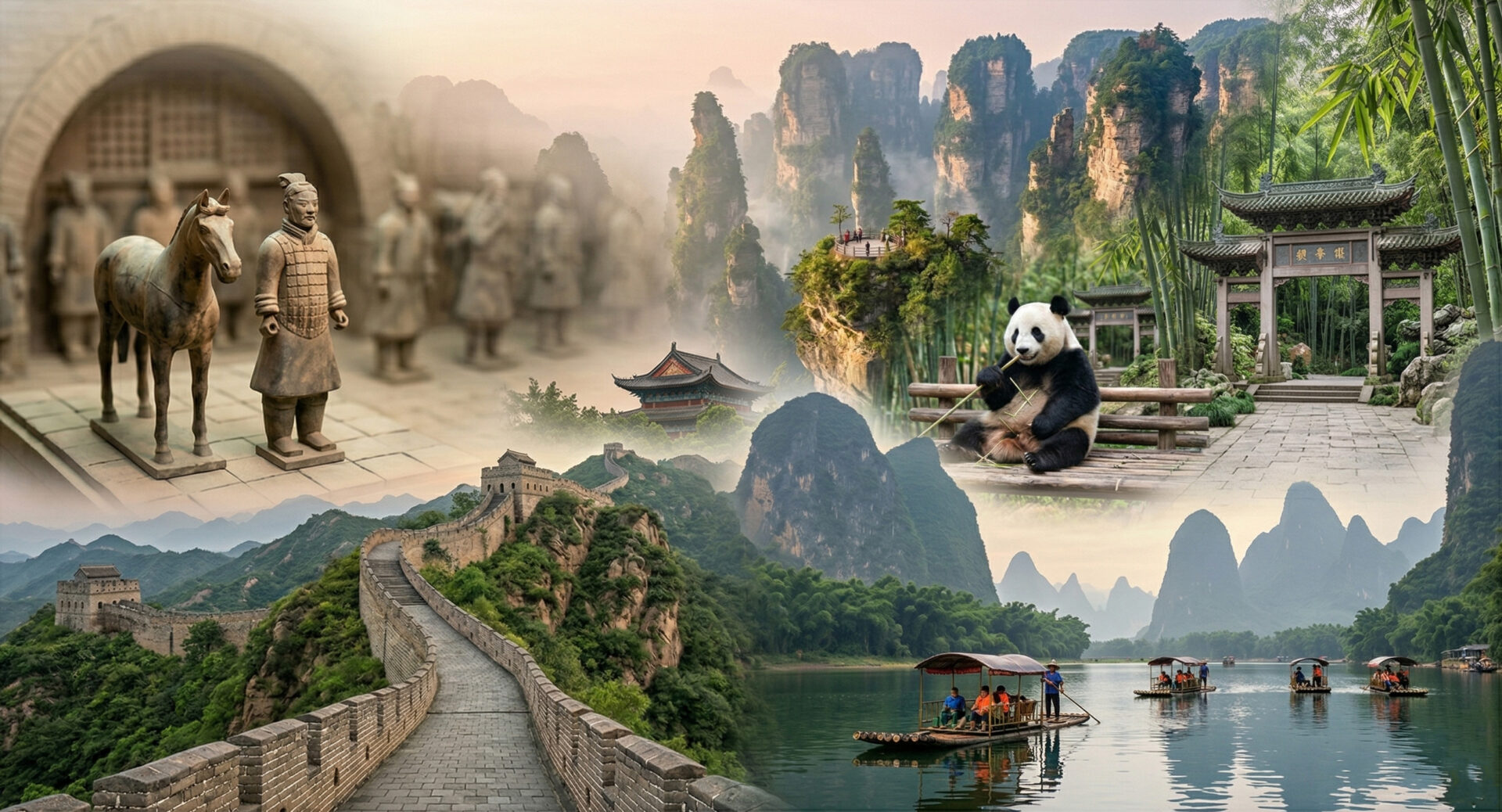
If you only get one trip to China, where should it go? Our shortlist, organised the way people actually plan — by what you want to look at, not by administrative region.
China is not a destination, it’s a continent with one flag. Ranking it properly is impossible, so here is the next best thing: the places we send people to first, grouped by the kind of trip you’re actually trying to take.
If you only get one province: Yunnan
Forced to pick a single province, we’d pick Yunnan without much argument. It holds more distinct landscapes than any other, and more of China’s ethnic minorities than anywhere else in the country — which means the food, architecture, festivals and languages change every few hours of driving.
The easy version of the trip runs north out of Kunming by train: Dali → Lijiang → Shangri-La. Old towns, a lake, then snow mountains, with Tiger Leaping Gorge walkable in a day between the last two stops.
Head south instead and it turns tropical. Xishuangbanna is Dai country, warm year-round and close enough to the Laos and Vietnam borders to feel like it; the Red River valley to the east holds the Hani rice terraces, which are at their best flooded and mirror-flat in late winter. Up on the Sichuan border there’s Yanjin, a county so hemmed in by cliffs that the town is essentially one street wide.
Where to aim in Yunnan:
- Dali — Erhai lake, Cangshan behind it, Bai towns in between
- Lijiang and Shangri-La — old town, gorge, then the plateau
- Menglian and the far south — Dai temples, Burmese border markets
- Hani rice terraces — Azheke village, terraces to the horizon
- Pu’er — where the tea comes from, literally
- Yanjin — the narrowest city in the country
For landscape
Karst: Guangxi, Hunan, Guizhou
This is the China of ink paintings, and it is genuinely as advertised. Zhangjiajie’s sandstone pillars in Hunan — the Avatar mountains — take about three days to do properly. West of there, Guangxi and Guizhou hold the classic limestone country: Guilin and Yangshuo for river-and-peak scenery, Xingyi for something less trodden, and Guangxi also hides Asia’s widest waterfall and the world’s deepest sinkholes.
All of it is well-served, cheap to sleep in and slow-paced — the easiest region on this list to travel with family.
Alpine: western Sichuan, northwest Yunnan, southern Gansu
Snow peaks over grassland, at Alps scale but with monasteries instead of chalets. Western Sichuan (Ganzi and Aba prefectures) has Litang at 4,000 m and villages like Eya and Muli far up the valleys; northwest Yunnan gives you Shangri-La and Deqin under Meili Snow Mountain; southern Gansu has Langmusi on the Sichuan border.
The useful thing about all three: they’re culturally Tibetan without being in the Tibet Autonomous Region, so no permit is required. The catch is rail access — outside Yunnan you’re on buses, which is why this region rewards driving yourself.
The plateau: Tibet
Average elevation above 4,000 m, air at two-thirds pressure, and a horizon that does something to your sense of scale. From the north face of Everest to Mount Kailash, the holiest mountain in Asia, down to the subtropical dead-end of Medog — the range within one region is absurd.
Two conditions: you need a Tibet travel permit, and you must travel with an organised tour. Independent travel isn’t permitted.
Grass and sand: Inner Mongolia
Inner Mongolia stretches most of the way across the top of the country, which lets it contain both the Ujimqin grasslands and the Badain Jaran — dunes over 400 m tall with lakes at their feet.
Go in summer, when the grass is high enough to move in the wind. Between October and April there’s very little to see and a great deal of wind to see it in; we wouldn’t plan a winter trip here.
Everything at once: Xinjiang
China’s largest region, roughly four times the size of Germany, and it does not specialise: 8,000 m peaks and sand seas in the south, grassland through the middle, alpine forest and snow in the north.
Along with Yunnan it’s the most culturally layered part of the country — Central Asian food, a dozen languages, and towns that feel closer to Samarkand than to Shanghai.
Where to aim:
- Kashgar — the oldest continuously inhabited city on the Silk Road
- Yining — Russian shopfronts, Kazakh countryside
- Turpan and Shanshan — grape trellises and the hottest ground in China
- Tacheng — the Kazakh border county
- Tashkurgan — Tajik villages at 3,000 m
- The Karakoram Highway — glaciers to the Pakistan border
For cities
Beijing
The most complete imperial capital anywhere. The Forbidden City and Temple of Heaven are the obvious pair, but the Great Wall is the reason to stay an extra day — and not at Badaling, which is the crowded one. Jinshanling, Jiankou or Mutianyu give you the same wall with a fraction of the people.
Shanghai
The one Chinese city that reads as fully international. The Bund after dark, the plane-tree streets of the former French Concession, and a café-and-restaurant density that rivals anywhere in Asia.
Chongqing
Chongqing is a city only this country’s geography could produce: towers stacked into a mountainside so thoroughly that the “ground floor” you walked in on turns out to be the 28th. Vertical, humid, neon-lit, motorbike-mad after dark — and the hometown of the most aggressive hotpot in China.
Hangzhou
Elegant in a way that’s rare at this size. West Lake sits in the middle of the city, tea terraces climb the hills inside the municipal boundary, and the whole place is startlingly clean and well-run. It’s the only major Chinese city where urban life and working tea countryside genuinely overlap.
Shenzhen
Shenzhen is forty years old and behaves like it: drone deliveries, driverless taxis, more skyscrapers than any other Chinese city, and a nightlife scene with no traditions to respect. There are beaches, and Hong Kong is a metro ride away.
Before you go
- Translation app installed and tested
- eSIM sorted before you land
- Local SIM once you’re in
- Passport with you for trains, flights and ticketed sites
The full list is in our China travel guide.
Read next
→ Must-have apps → Getting around China → Internet and VPNs → How to pay → Safety → Restricted areas → Driving yourself
- #china essentials
- #itineraries
- #planning
- #destinations