
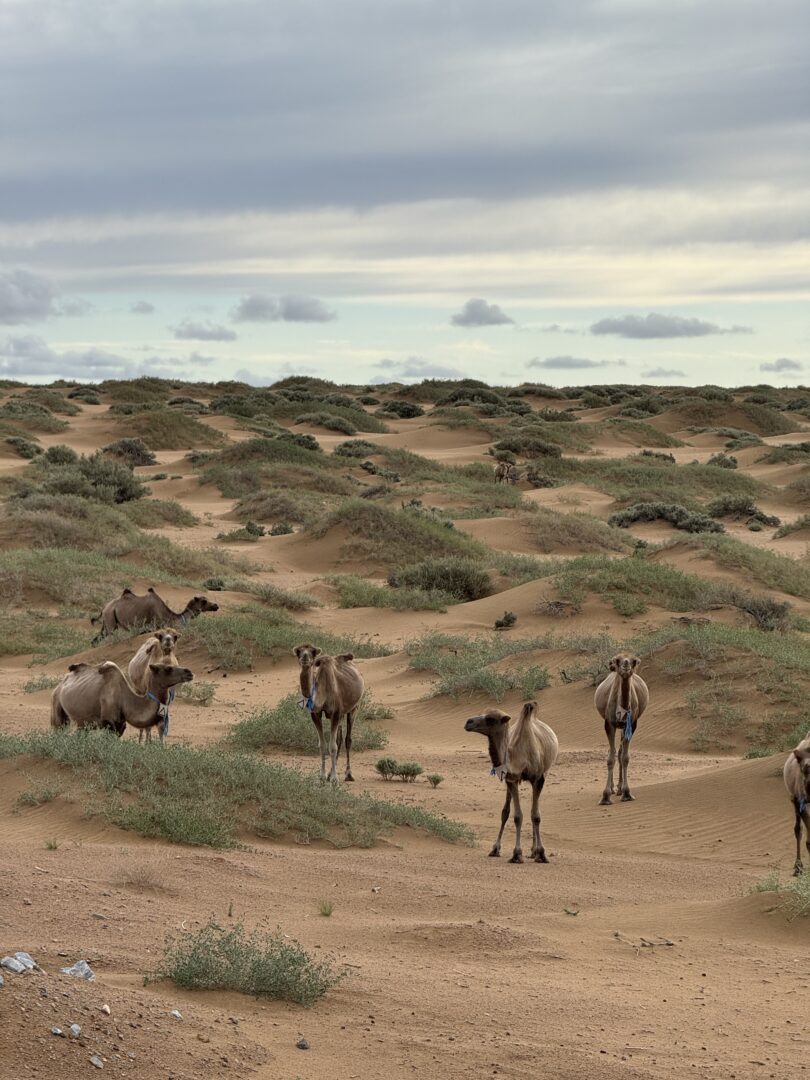
Dunes over 400 metres high, more than a hundred lakes between them, and sand that hums when it slides. Badain Jaran joined the UNESCO World Heritage list in 2024, and getting in still takes a hired 4WD and about 3,500 yuan.
Badain Jaran is the third-largest desert in China and it contains something no other desert does: stationary dunes over 400 metres tall — the highest in the world — with more than a hundred permanent lakes sitting between them.
Those two facts should not coexist. It’s why the place was inscribed as a UNESCO World Heritage site in 2024, and why standing at the top of a dune looking down at blue water surrounded by sand is one of the strangest views in China.
Getting to the edge
The approach is a journey in itself. From Alxa Left Banner it’s around 400 kilometres west to Alxa Right Banner, the last town before the desert, and the landscape hands over to Gobi gradually along the way.
Something worth noticing on that road: the desertification control works. Grids of planted shrub, straw checkerboards and shelterbelts, extending for tens of kilometres. They’re effective — the advance of the sand has measurably slowed in this region over the past decade — and they’re an enormous, mostly unremarked piece of civil engineering.
Settlements along the way are tiny. We stopped at Bayannourigong Sumu, a seasonal hamlet with a handful of farmers and essentially no traffic, which is representative of the whole stretch.
The route in
The desert itself
The dunes. Bilutu and the other giants rise more than 400 metres from base to crest. Climbing one takes far longer than it looks and the descent takes ninety seconds.
The lakes. Around 140 of them, some fresh, some highly saline, ringed with reed and occasionally flamingo-pink with algae. The hydrology isn’t fully settled, but the working explanation is groundwater moving in from the Qilian and Helan ranges combined with what little rain falls. The Mongolian name is usually glossed as “mysterious lakes.”
The singing. Dry sand avalanching down a lee slope generates a low, resonant hum — loud enough to feel. Marco Polo wrote about “the ghosts of the desert,” and this is generally taken to be what he meant.
The monastery. A small temple stands beside one of the largest lakes, built in the 19th century, and monks lived out here permanently. It’s still standing, in the middle of a sand sea, which tells you something about both faith and logistics.
What it costs, and how it works
Be prepared for this, because there is no cheap version and no bookable package.
- You must hire a driver with a 4WD. No exceptions; the routes are soft sand.
- Entrance ticket: around 1,000 yuan per person
- Driver: at least 1,500 yuan for an overnight trip
- Yurt camp with dinner: around 1,000 yuan
That’s roughly 3,500 yuan (about US$490) per person for a one-night desert expedition. There is no tour operator to book with in advance and no hotel inside to reserve — the mechanism is to arrive in Alxa Right Banner, stay a night, and have your hotel arrange a driver for the morning.
Costs are shared if there are several of you, which is the one lever available.
Is it worth it
Yes, on one condition: stay the night. A day trip is a long drive to look at sand. Staying gets you the dunes at sunset, the lakes at dawn, and a sky at 1,200 metres with no settlement within a hundred kilometres — which is as good as stargazing gets in China.
Practical notes
Base: Alxa Right Banner. Several straightforward hotels, all of which arrange drivers.
When: May to October. Summer daytime heat is severe and nights are cold in any season — bring layers regardless of the forecast.
Bring: far more water than you plan to drink, sun protection, something over your face for wind, and cash as a backup.
Nearby: Alxa Left Banner and the Helan mountains to the east, and Zhongwei in Ningxia beyond that.
- #inner mongolia
- #badain jaran
- #desert
- #unesco
- #dunes