
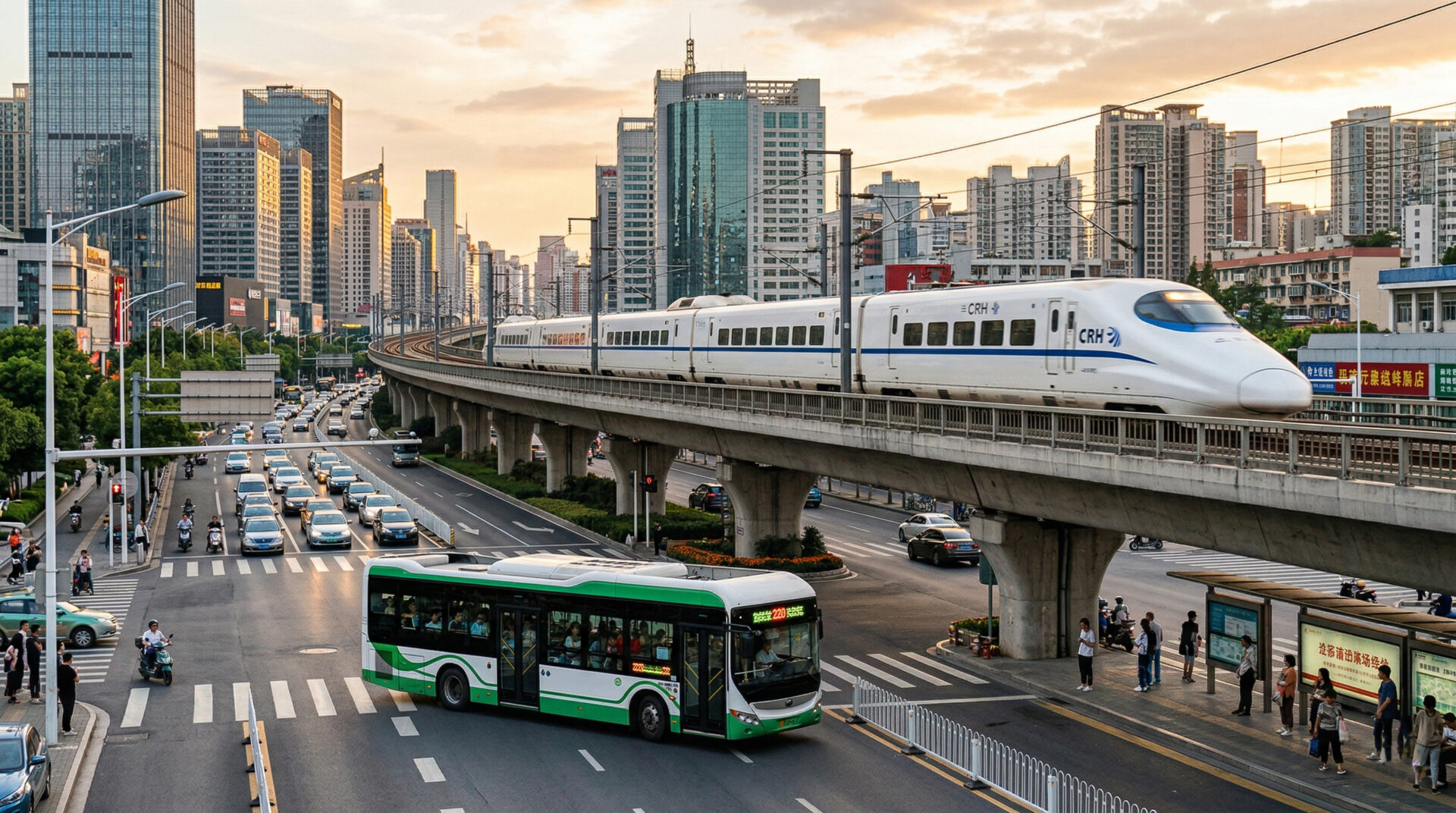
China's transport network is the best argument for the country's own competence. Here's how to choose between train, plane, metro and minivan, and how to pay for all of it with a phone.
Distance decides the mode. Under about five hours, take the train; over that, fly. Inside a city, the metro plus a bike; beyond the rail network, a bus or a shared minivan. That’s the whole decision tree, and once you know it, moving around China is close to effortless.
High-speed rail
China has the largest high-speed network on earth and it shows: every provincial capital is on it, along with a long list of prefecture towns that would never have justified an airport.
For medium distances it beats flying outright once you count the transfer to a peripheral airport, the security queue and the boarding. Trains leave from stations in the middle of cities, run to the minute, and give you a reserved seat every time.
Practicalities: book through an English-language platform or the official 12306 app, arrive 30–40 minutes early for the security check, and at most large stations you can walk to the platform on your passport alone — the ticket is a record, not a piece of paper.
City metros
Nearly every large Chinese city has one, and they are uniformly clean, modern and fast. Fares typically land between a couple of yuan and about seven, depending on distance — cents, not dollars.
They’re also the easiest thing in the country for a non-Chinese speaker to use. Signage and announcements are bilingual, station layouts are consistent, and the network maps are colour-coded the same way everywhere.
To pay, open Alipay’s transit function, generate the QR code, and scan it at the gate. No card, no ticket machine, no change.
Local buses
Buses are the cheapest way to move — often under three or four yuan flat — and they go where the metro doesn’t. In smaller cities they are the public transport system, and a surprising number of rural areas are reachable by nothing else.
The catch is language. Route information is usually Chinese-only, stop names assume local knowledge, and the numbering logic isn’t obvious. Amap solves most of this: enter a destination, and it gives you the bus number, the stop, the direction and the live arrival time.
Ride-hailing and taxis
DiDi is the default. It works in every city and most county towns, prices below metered taxis, locates you automatically, offers several service tiers, and pays through WeChat or Alipay.
Street taxis are everywhere too, but DiDi removes the two friction points that matter for a visitor: explaining the destination, and agreeing the fare. The address is already in the app, and the price is fixed before you get in.
Domestic flights
Worth it above roughly 1,000 km — Beijing to Kunming, Shanghai to Ürümqi, anywhere to Lhasa. The main hubs are Beijing, Shanghai, Guangzhou and Chengdu, and domestic fares are reasonable if you book more than a week ahead.
Below that distance the train usually wins on total door-to-door time, comfort and price.
⚠️ Power banks: domestic flights require a visible CCC certification mark on the battery. Uncertified ones get confiscated at security, regardless of capacity.
Paying for any of it
Transport is essentially cashless. WeChat Pay and Alipay cover metros, buses, taxis, ride-hailing and rail booking, all by scanning a code on the way in or out.
Ticket machines still exist in metro stations, and a handful of cities sell stored-value transport cards, but both are now the fallback rather than the norm. Setting up mobile payments before you travel is the single highest-leverage bit of preparation you can do — see the payments guide for how.
Practical tips
- Avoid 7:30–9:00 and 17:30–19:00 in any large city unless you enjoy being compressed
- Install Amap before you need it, not while standing at a bus stop
- Book long-distance trains well ahead around Spring Festival, the October holiday and Qingming — they sell out completely
- Get to train stations early; the security check is real and the queue is unpredictable
- Keep your passport on you, always. It’s your train ticket, your flight ID and your museum entry
Is it safe?
Yes — conspicuously so. Stations are staffed and monitored, platforms are screened, services run on time, and the infrastructure is new enough that maintenance hasn’t become visible. Most first-time visitors are surprised less by the technology than by how orderly the whole thing is.
For the broader picture, see our guide to safety in China.
- #china essentials
- #transport
- #high-speed rail
- #metro
- #planning