
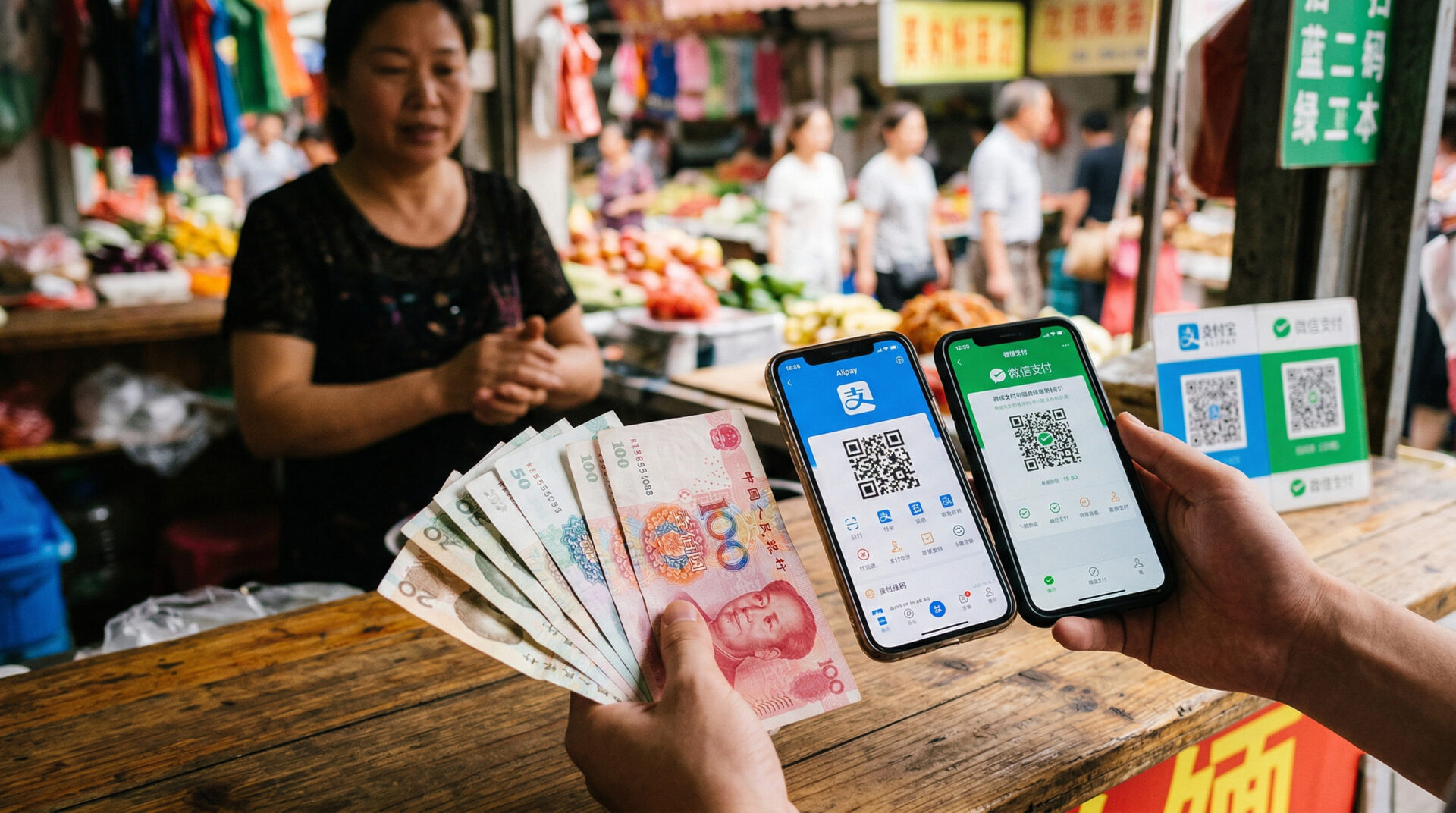
China didn't move from cash to cards to phones. It went from cash to phones, and left the middle step out. Two apps, one passport verification, a few days of lead time.
Not cashless. Card-less.
Most countries went cash → cards → phones. China skipped the middle step, which is why a payment habit that works across Europe or North America can leave you stuck at a noodle counter here.
Two apps carry almost all of it:
- WeChat Pay
- Alipay
Between them they cover restaurants, taxis, supermarkets, hotels, malls, ticket offices and the man selling roasted sweet potatoes out of an oil drum. Travelling without them isn’t impossible, just needlessly hard.
Get the rest of your app setup sorted at the same time.
Does cash still work?
Legally, yes. Practically, less every year.
- Many places genuinely cannot make change, because nobody hands them notes
- Some vendors would rather not deal with cash at all
- The smallest businesses may have no float whatsoever
Cards are more restricted still. Outside international hotel chains, airports and upmarket malls, Visa and Mastercard are usually not accepted — and that includes Apple Pay, Google Pay and Amex, which run on the same rails.
Carry two or three hundred yuan for the day your phone dies. Don’t build a trip around it.
The two apps
WeChat Pay
Built into WeChat, alongside messaging and everything else that app does. You’ll use it to scan a merchant’s code, to send money to a person, and to pay in shops, restaurants and taxis.
Worth understanding: scanning a QR code with WeChat or Alipay usually opens a mini-program — a small app running inside the host app. That’s how you order food at a table, unlock a bike, buy a park ticket or register at a front desk. It looks like a website and behaves like an app, and you never install anything.
Alipay
The other rail, and typically the smoother of the two to set up as a foreigner. Same QR-code model, plus its own booking layer for transport, hotels and attractions, and the transit-ticket function most city metros accept.
Install both. A small number of vendors take only one, and it’s never the one you’d guess.
Setting up as a tourist
Both apps now accept foreign Visa and Mastercard.
- Download WeChat and Alipay
- Register and complete identity verification with your passport — this can take three to four days
- Add a foreign Visa or Mastercard
- Start scanning
Verification is the part that catches people. It is not instant, some banks decline the first card attempt, and it cannot be rushed from a hotel lobby on arrival day.
Do all of this before you fly.
What it looks like in practice
Once you’re set up, there are only two motions:
- The vendor shows a QR code → you scan it, enter the amount, confirm
- You show your own payment code → the vendor scans you
The transfer clears instantly; larger amounts ask for the PIN you set during registration. That’s it — same gesture in a Michelin-listed dining room and at a breakfast cart, in Shanghai and in a Qinghai county town.
Credit cards: the honest answer
They’re not part of daily life here, so most shops, restaurants and hotels simply aren’t set up to take them. There are exceptions — luxury hotels, airports, international chains — but building a trip around finding those exceptions is a worse plan than spending twenty minutes on app registration before you leave home.
The four mistakes to avoid
- Planning to pay cash
- Installing only one of the two apps
- Arriving with no mobile data — every payment needs a connection
- Leaving registration until arrival, then losing three days to verification
Read next
→ Top 10 destinations → Must-have apps → Getting around China → Internet and VPNs → Safety → Restricted areas
- #china essentials
- #payments
- #wechat pay
- #alipay
- #planning