
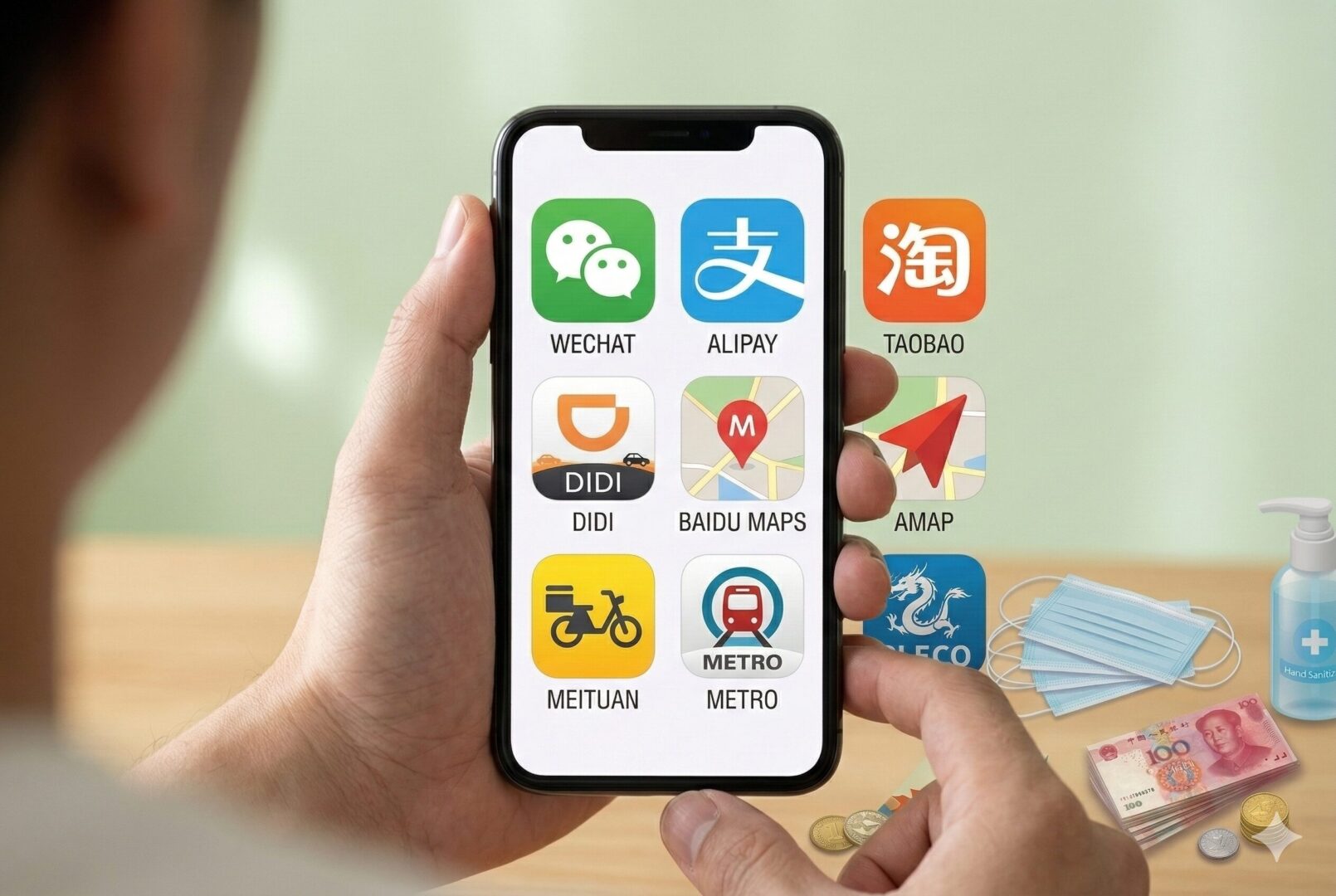
China runs on six or seven apps, and two of them need days of identity verification before they'll take your money. Install those at home. Here's the working set and what each one is really for.
Two of these need to be installed and verified before you get on the plane. Everything else can wait until you land. That single piece of sequencing is the difference between a smooth first week and a frustrating one.
WeChat (微信)
Imagine WhatsApp, Instagram and PayPal merged, then given an app store of its own. That’s WeChat, and it is closer to infrastructure than to software here.
You’ll use it to message people, to pay for things, and — most usefully — to open mini-programs: small apps that live inside WeChat and never need installing. Ordering at a restaurant, unlocking a shared bike, buying a bus ticket, filling in a museum’s registration form: all of it is a QR code that opens a mini-program. Between WeChat and Alipay, those two apps scan essentially every code in the country.
WeChat Pay is the dominant payment rail. Restaurants, hotels, taxis, market stalls, temple donation boxes — all of them take it. You can link an international Visa or Mastercard and have charges pass straight through to it.
⚠️ Do this at home. Setting up WeChat Pay requires identity verification with a passport upload, and approval can take a couple of days. Arriving in China with an unverified account means arriving with no way to pay for lunch.
Alipay (支付宝)
The other half of the duopoly, and generally the friendlier one for foreign cards. Same model: a big scan button, a linked card, and mini-programs behind most QR codes. Alipay also handles metro tickets in most cities, and it’s what many airports point you at for the digital arrival card.
Same warning applies — verification takes days, so register before you travel. Most travellers end up running both apps, because a small number of vendors accept only one.
A booking platform
For hotels, flights, trains, buses and attraction tickets, use one of the large China-focused travel agencies. They work like the Western booking sites but with far deeper coverage of smaller cities, and they’re the only realistic way to book domestic trains and flights in English.
If you read Chinese, Qunar and the domestic apps often shave a little off the price and list guesthouses the international interfaces never surface — they’re domestic-only and Chinese-only.
DiDi (滴滴出行)
China’s ride-hailing app, and the easiest way to move around any city after the metro closes. It has an English interface, covers essentially every city and most county towns, and pays through WeChat or Alipay.
One quirk worth knowing: switching the interface to Chinese exposes extra service tiers and slightly cheaper options that the English version hides.
Car rental (Shenzhou 神州租车 / eHi 一嗨租车)
Both have English interfaces and will rent to foreign drivers — with one hard requirement. An international driving permit is not valid in mainland China on its own. You need a Chinese temporary driving permit, issued against your home licence and passport, and depending on the city you can arrange it before arrival or on the day.
If you’d rather not deal with that, trains plus DiDi covers almost everything. The exceptions are the places worth driving for — grassland, plateau, and anywhere with more villages than bus routes.
Amap (高德地图)
Use this instead of Google Maps, which in China is years out of date. Amap has accurate live navigation for walking, driving, cycling and transit, plus restaurant and attraction data and a taxi-hailing tab.
The interface is mostly Chinese, but the map itself is legible in any language and the routing is the best available. If you install one navigation app, this is the one.
Delivery: Ele.me (饿了么) and Meituan (美团)
The two big food-delivery platforms, covering everything from single-wok noodle shops to national chains. Both are Chinese-only, which puts off short-term visitors — understandably, since ordering involves reading a menu.
If you’re staying more than a week or two, it’s worth learning the basic flow. The prices are low, the delivery is fast, and on the evening you can’t face going out again, it’s a small mercy.
Getting around the firewall
Anything non-Chinese needs help: Google in all its forms, WhatsApp, Instagram, Facebook, most Western news sites, and — surprisingly often — your bank’s app.
- Install and test your solution before you arrive. Many of the relevant websites and app-store listings are blocked from inside China, so fixing it later is genuinely hard.
- A travel eSIM with international routing is the most consistently reliable approach we’ve seen, and it needs no configuration on the ground.
- Plenty of VPN providers advertise that they work in China; a decent share don’t, and the ones that do stop working intermittently.
Detail on all of this is in the internet and VPN guide.
The three mistakes that cost the most
- Leaving the eSIM install until after you land
- Not verifying WeChat Pay and Alipay before the trip
- Skipping the local SIM, then failing SMS verification on half the apps above
Read next
→ China travel guide 2026 → Top 10 destinations → Getting around China → Internet and VPNs → How to pay → Safety → Restricted areas
- #china essentials
- #apps
- #alipay
- #planning