
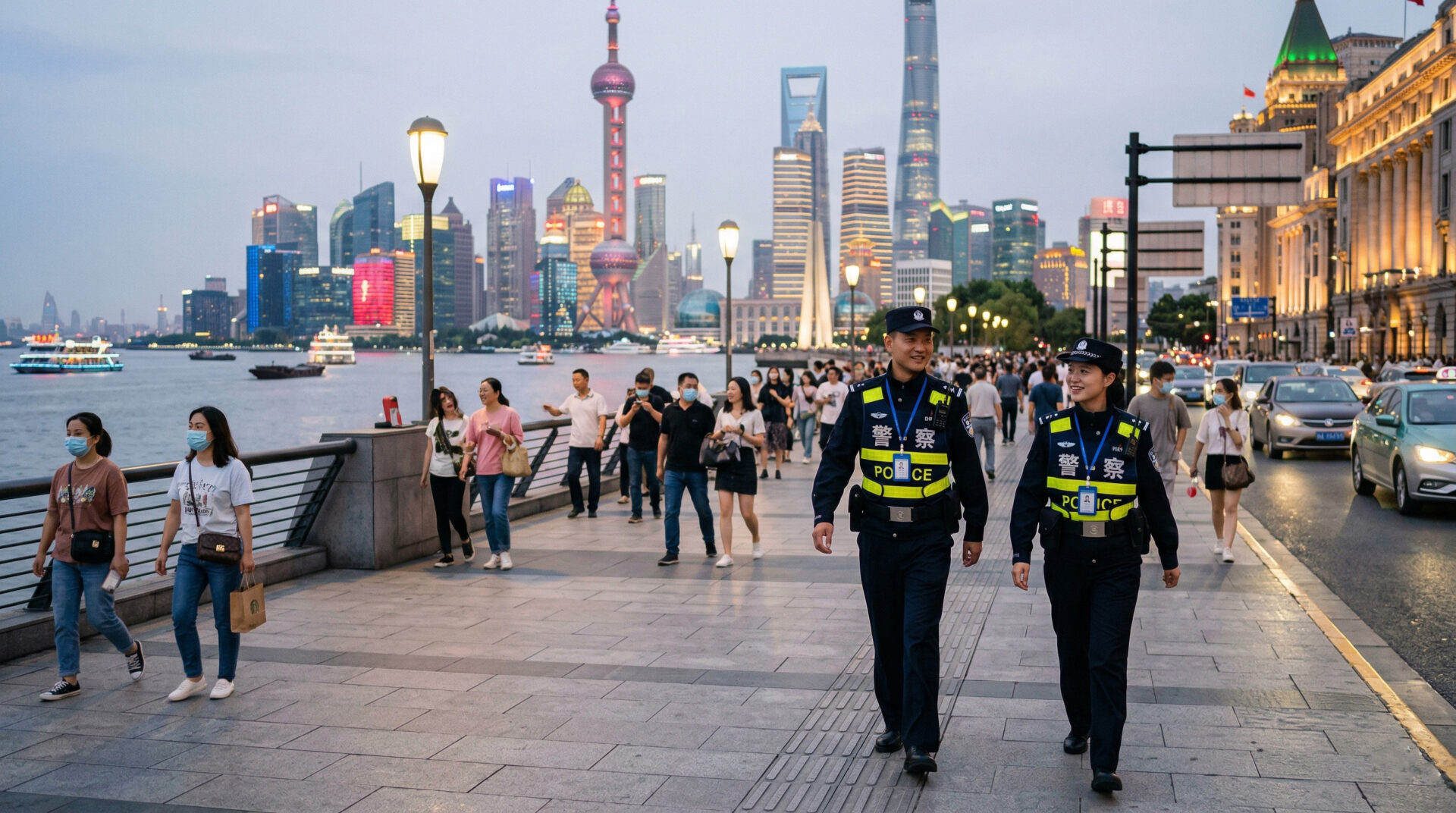
China is one of the safest large countries to travel in, and most visitors notice it within a day. The genuine risks are environmental rather than criminal, which changes what you should actually prepare for.
Is China safe?
Yes, and by most measures conspicuously so — for visitors, residents and locals alike.
Violent crime is rare by the standards of almost any Western country. Walking a city at midnight is unremarkable here, and that holds for women travelling alone as much as anyone else: what you wear is not a safety calculation in Chinese cities.
Police are visible in urban centres and public space is heavily monitored, which most visitors experience as reassuring rather than oppressive. The short version: China sits near the top of any honest ranking of safe major destinations.
Crime, realistically
Crime against tourists is uncommon, but “uncommon” isn’t “impossible.” Pickpocketing happens in crowded markets and on packed metros. Occasional scams and overpriced unofficial taxis exist, mostly around big tourist sites and mostly avoidable by using DiDi.
If something is stolen, go to the nearest police station immediately rather than writing it off. Chinese police are well equipped for exactly this, camera coverage is dense, and recovery rates are unusually high — often the same day.
Digital safety
Local apps are trustworthy at the level that matters. WeChat and Alipay handle payments for a billion people daily and are secured accordingly.
The one nuisance is scam phone calls — a stranger selling something, offering a job, or claiming to be from a delivery company. If you don’t speak Chinese the conversation ends itself; if you do, hang up. Never act on instructions from an unsolicited call, and never move money because of one.
Solo travel and women travellers
China is one of the more comfortable countries in the world for solo travel.
- Walking alone at night in cities is genuinely low-risk
- Street harassment is rare, and rarer than in most Western cities of comparable size
- Public spaces are well-lit, busy late, and monitored
Standard travel awareness still applies — it always does. But the baseline is high.
The real risks: weather and air
This is where preparation actually pays.
China spans several climate zones and a lot of active geology, so the hazards are regional and seasonal. Typhoons hit the southeast coast from roughly July to September. Sandstorms sweep the northwest in spring. Summer flooding affects river basins, and the mountain west has earthquakes. Check the forecast for the specific region rather than the country.
Air quality deserves specific attention. It has improved dramatically over the last two decades, but a bad-air day in a large northern city is still worse than anything most European visitors are used to. If you’re asthmatic or sensitive to particulates, bring FFP2 or FFP3 masks, install an AQI app, and plan indoor days when the number spikes.
Emergency numbers
- Police: 110
- Ambulance: 120
- Fire: 119
- Government service hotline: 12345 (for disputes, including hotel check-in problems)
Save them before you fly. English support is inconsistent, so having a translation app open when you call is a good idea.
The four things people actually get wrong
- No translation app installed, so no way to ask for help
- Connectivity not sorted before arrival — see the internet guide
- No local SIM, so no verification codes and no local number to be reached on
- Passport left in the hotel on a travel day
Read next
→ Top 10 destinations → Must-have apps → Getting around China → Internet and VPNs → How to pay → Restricted areas
- #china essentials
- #safety
- #solo travel
- #air quality