
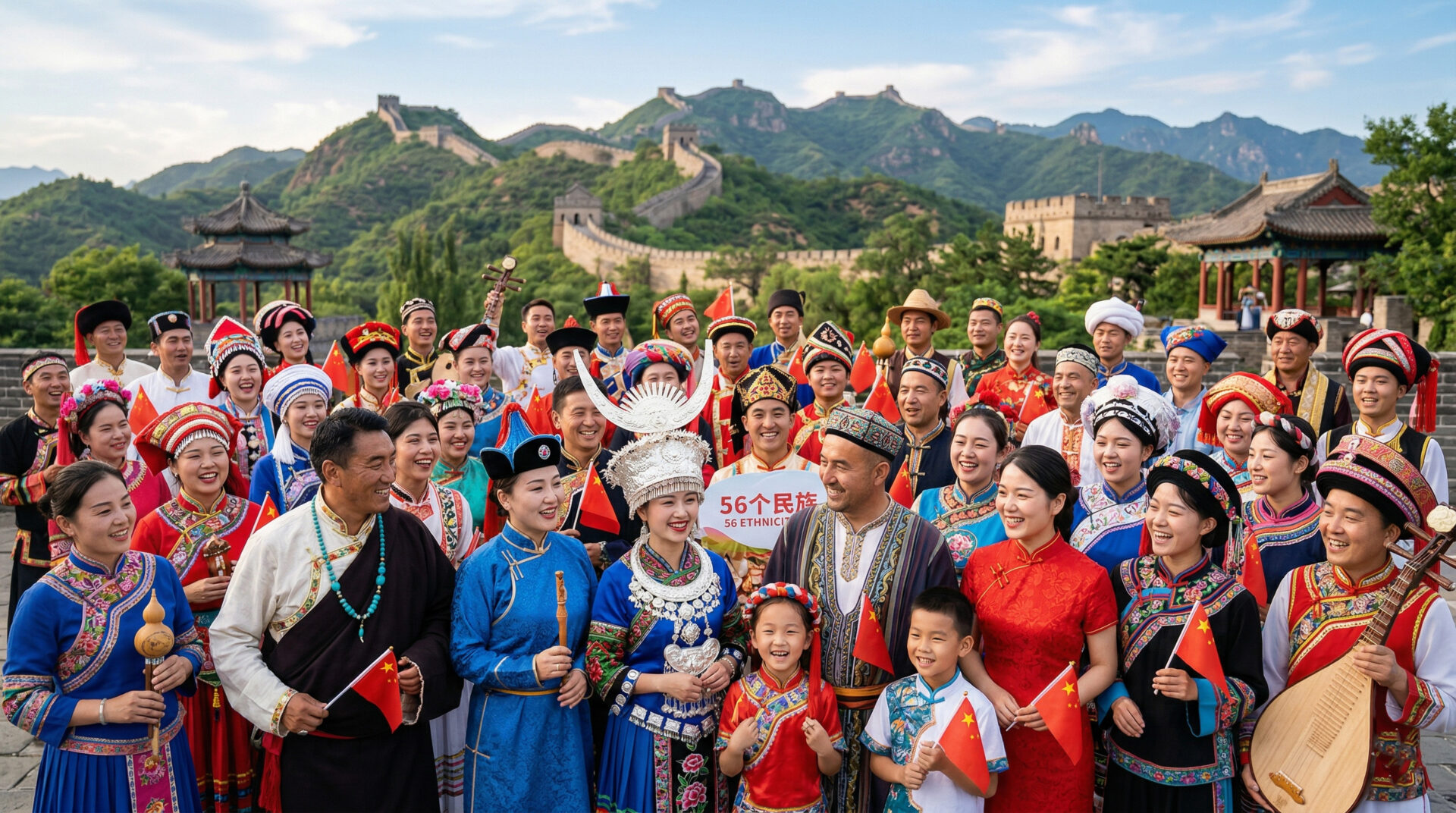
China officially recognises 56 ethnic groups: the Han plus 55 minorities, spread from Siberian reindeer forest to tropical Buddhist lowlands. A regional guide to who's where and what makes each distinct.
China officially recognises 56 ethnic groups: the Han majority plus 55 minority nationalities. Between them they account for languages from five different families, three world religions, several writing systems, and ways of living that range from reindeer herding above the Arctic treeline to wet-rice farming in the tropics.
It is the single most under-appreciated thing about travelling here. Cross a prefecture boundary and the architecture, the script on the signs, the staple grain and the music all change.
Here’s who’s where.
The majority
Han (汉族)
📍 Nationwide
Ninety-one percent of the population, and far less uniform than that number implies. A Cantonese speaker in Guangzhou and a Shanghainese speaker in Pudong are both Han and cannot understand each other’s mother tongue. The cuisine spans Sichuan hotpot and Cantonese dim sum — dishes with almost nothing in common but a writing system. What holds it together is written language, ancestor veneration and a shared Confucian inheritance rather than anything you could point to on a map.
The northern steppe and forest
Mongol (蒙古族)
📍 Inner Mongolia
Grassland, livestock and horses, organised around seasonal movement. Long-song and throat-singing, wrestling festivals, and a diet built on lamb, dairy and airag — fermented mare’s milk. See the Ujimqin grasslands.
Manchu (满族)
📍 The northeast
Rulers of China for 268 years and now largely assimilated; only a handful of elderly speakers remain fluent. The legacy survives in Beijing’s imperial architecture and in northeastern food — the ancestor of modern hotpot among it.
Daur (达斡尔族)
📍 Inner Mongolia
Farmers with steppe roots. Their traditional field hockey — beikou — is genuinely ancient and still played in village matches.
Oroqen (鄂伦春族)
📍 Heilongjiang, Inner Mongolia
Forest hunters until the mid-twentieth century, living in birch-bark lodges and moving with the game. One of China’s smallest recognised groups.
Ewenki (鄂温克族)
📍 Inner Mongolia
Among the last reindeer herders in Asia, in the forests of the Greater Khingan range. The culture reads as Siberian rather than Chinese: taiga living, animist practice, reindeer as transport and larder both.
Hezhen (赫哲族)
📍 Heilongjiang
Fishing people of the Amur and Ussuri rivers, historically known for making clothing from tanned fish skin — a technique that has to be seen to be believed.
The Silk Road and Muslim China
Hui (回族)
📍 Nationwide
Visually indistinguishable from Han neighbours, culturally distinct through Islam: mosques, halal kitchens, no pork. Their food travels better than almost any in China — the Lanzhou hand-pulled noodle shop is a national institution. See Shadian and Xunhua.
Uyghur (维吾尔族)
📍 Xinjiang
Turkic-speaking and Muslim, with a culture built around the bazaar, music, dance and bread. Naan from a clay oven, lamb over charcoal, hand-pulled laghman. Appearance varies enormously — Central Asian to European. Start in Kashgar.
Kazakh (哈萨克族)
📍 Xinjiang
Still substantially semi-nomadic: families move livestock between summer and winter pasture on a fixed annual cycle. Yurts, horses, and a living tradition of hunting with golden eagles. See the Jiangbulake nomads and Tacheng.
Kyrgyz (柯尔克孜族)
📍 Xinjiang
High-mountain herders with one of the world’s great oral epics — the Manas, longer than the Iliad and Odyssey combined, still recited from memory.
Tajik (塔吉克族)
📍 The Pamirs
The outlier among their Turkic neighbours: an Indo-European language, Ismaili Islam, and villages farming at over 3,000 m. See Tashkurgan.
Uzbek (乌孜别克族)
📍 Xinjiang
Historically the merchant class of the oasis cities — trade, textiles and the long-distance networks that made the Silk Road work.
Tatar (塔塔尔族)
📍 Xinjiang
One of the smallest groups in the country, historically urban and unusually well-educated, with visible European influence in dress and custom.
Salar (撒拉族)
📍 Qinghai
Muslim, Turkic-speaking, and firmly their own thing — neither Hui nor Uyghur. Concentrated around Xunhua on the Yellow River.
Bonan (保安族)
📍 Gansu
Famous for knife-making. The Bonan blade is the cultural signature and still a working craft.
Dongxiang (东乡族)
📍 Gansu
A Mongolic-speaking Muslim community in the loess hills, socially conservative and tightly knit. See the Dongxiang community.
The Tibetan plateau
Tibetan (藏族)
📍 Tibet, Qinghai, western Sichuan, Gansu, northwest Yunnan
Life organised around Buddhism — monasteries, prayer wheels, pilgrimage circuits walked over months. Barley, yak meat and butter tea, because at 4,000 m that is what grows and what keeps you warm. Reachable without a permit in Litang, Langmusi and Tongren.
Monba (门巴族)
📍 Southeastern Tibet
Culturally close to Tibetans but forest-based rather than pastoral, in the deep valleys around Medog.
Lhoba (珞巴族)
📍 Southeastern Tibet
One of the smallest recognised groups — a few thousand people, traditionally hunters and shifting cultivators in remote valleys.
The southwest — where diversity peaks
Yi (彝族)
📍 Yunnan, Sichuan
One of the largest minorities and among the most culturally intact: own language and script, traditional dress worn as everyday clothing in the highlands, and the Torch Festival as the year’s centrepiece. See Butuo.
Bai (白族)
📍 Dali, Yunnan
Known for an aesthetic sensibility that shows in everything — whitewashed courtyard houses with painted gables, tea ritual, an unhurried pace. See Dali.
Hani (哈尼族)
📍 Southern Yunnan
Terrace engineers. The Hani rice terraces are a complete hydrological system built over a thousand years, forest above, village in the middle, water managed down through the fields. See Azheke.
Dai (傣族)
📍 Xishuangbanna, Yunnan
Southeast Asia inside China: Theravada Buddhism, palms, stilt houses, and the water-splashing New Year in April. See Menglian.
Lisu (傈僳族)
📍 Northwest Yunnan
Mountain specialists in the Nujiang gorges, in layered, brilliantly coloured dress. See the Nujiang valley.
Lahu (拉祜族)
📍 Southwest Yunnan
Highland farmers and tea growers along the Myanmar border, with a strong tradition of group song and gourd-pipe music.
Wa (佤族)
📍 Southwest Yunnan
A distinct tribal identity along the Myanmar frontier. Historically known for headhunting — long discontinued — and today for wooden drum culture and a hair-dance that has become the region’s signature. See Ximeng.
Naxi (纳西族)
📍 Lijiang, Yunnan
Custodians of Dongba script, one of the last pictographic writing systems still understood by living practitioners, and of a religious tradition blending Bön, Buddhism and Daoism. See Lijiang.
Jingpo (景颇族)
📍 Western Yunnan
A martial history, strong clan structure, and the Munao Zongge — a mass line-dance festival that runs for days.
Pumi (普米族)
📍 Northwest Yunnan
A blend of Tibetan Buddhism and older local belief, with a semi-nomadic past still visible in how villages use high pasture.
Nu (怒族)
📍 The Nujiang valley
A few tens of thousands of people in one of the deepest gorges in the world, where geography did most of the cultural shaping. See Cizhong.
Drung (独龙族)
📍 Northwest Yunnan
Among the most isolated communities in China, in a valley snowed shut for months each year. Facial tattooing was once a coming-of-age rite for women; a handful of the last tattooed elders are still living.
The south and the coast
Zhuang (壮族)
📍 Guangxi
The largest minority in China at nearly 18 million. Wet-rice farming, antiphonal folk song, and a strong regional identity across the karst country. See Guilin and Yangshuo.
Bouyei (布依族)
📍 Guizhou
Village-centred farming communities with a deep oral tradition — genealogies and ritual texts held in memory rather than writing.
Miao (苗族)
📍 Guizhou, Hunan, Yunnan
Extraordinary craftspeople: silver headdresses weighing kilos, indigo batik, embroidery that identifies your village at a glance. Dozens of subgroups, each visually distinct. See Guizhou’s villages.
Yao (瑶族)
📍 Guangxi, Hunan
Known for herbal medicine and, in the Red Yao villages, for hair kept at floor length and washed in fermented rice water.
Dong (侗族)
📍 Guizhou, Guangxi, Hunan
The great builders — drum towers and covered bridges assembled without nails or plans, and the kgal laox polyphonic choral tradition, which predates any European equivalent.
Shui (水族)
📍 Guizhou
Keepers of Shuishu, a ritual script of several hundred characters used only by priests, for divination and calendars.
Tujia (土家族)
📍 Hunan, Hubei, Guizhou
Stilt houses stepped into hillsides, and the hand-waving dance — a New Year mass dance with thousands of participants. See Zhangjiajie.
Gelao (仡佬族)
📍 Guizhou
One of the oldest documented populations of the region, now small in number but strongly attached to distinct ritual practice.
Maonan (毛南族)
📍 Guangxi
Farmers of the limestone hills, with a festival calendar tightly bound to the agricultural year.
Mulam (仫佬族)
📍 Guangxi
Close-knit rural communities in northern Guangxi, with their own Kam–Tai language and a distinctive ancestor-hall tradition.
She (畲族)
📍 Fujian, Zhejiang
A long migratory history now settled into mountain villages, with women’s headdresses and wedding customs preserved in remarkable detail.
Li (黎族)
📍 Hainan
The indigenous people of Hainan island — fishing, tropical farming, and a brocade-weaving tradition that predates cotton in China. See rural Hainan.
Gaoshan (高山族)
📍 Taiwan, with a small mainland population
An umbrella term for Taiwan’s indigenous peoples, whose Austronesian languages tie them to the Philippines and the Pacific rather than to the mainland.
The northeast border
Korean (朝鲜族)
📍 Jilin
Bilingual, concentrated in the Yanbian prefecture along the North Korean frontier. Kimchi, cold noodles, Korean-language schools and signage — the culture reads as distinctly Korean. See the North Korean border.
Smaller and singular
Xibe (锡伯族)
📍 Xinjiang, Liaoning
Relocated from Manchuria to the Ili valley in 1764 as a garrison, and — remarkably — the only community to have preserved the written Manchu language into the present.
Achang (阿昌族)
📍 Western Yunnan
Blacksmiths. The Husa knife has been traded across southwest China and into Myanmar for centuries.
Blang (布朗族)
📍 Southern Yunnan
Among the oldest tea-cultivating peoples anywhere; their ancient groves are part of the Pu’er story. See Pu’er.
Jino (基诺族)
📍 Xishuangbanna
The last group to receive official recognition, in 1979 — one reason the traditions arrived in the modern era comparatively intact.
De’ang (德昂族)
📍 Western Yunnan
Tea and Theravada Buddhism structure the year. Known for waist-hoops worn by women as a mark of adulthood.
Russian (俄罗斯族)
📍 Xinjiang, Inner Mongolia
Descendants of settlers and refugees from across the border: Orthodox churches, timber houses, and a bread-and-pickle food culture. See Yining and Enhe.
Yugur (裕固族)
📍 Gansu
A Turkic-speaking Buddhist people in the Qilian mountains — an unusual combination — mixing herding with settled farming.
Qiang (羌族)
📍 Northern Sichuan
Builders of stone watchtowers up to thirty metres tall, still standing in valleys west of Chengdu, and one of the oldest continuously attested peoples in Chinese records.
Tu (土族)
📍 Qinghai
Mixed Mongol and Tibetan heritage, Tibetan Buddhist practice, and some of the most elaborate embroidery in the northwest. See Tongren.
Where to go to see it
If cultural diversity is what you’re travelling for, five regions carry most of it:
- Yunnan — 25 recognised groups in one province; the richest mosaic in China
- Guizhou — Miao and Dong villages, the least commercialised of the lot
- Xinjiang — Central Asia inside Chinese borders
- Tibet and western Sichuan — high-altitude Buddhist culture, with Sichuan needing no permit
- Guangxi — Zhuang and Yao communities against the best karst scenery in the country
- #china essentials
- #ethnic groups
- #culture
- #minorities