
For nearly three years, entering China meant a testing regime, a sealed bus and two or three weeks of hotel quarantine. It's all gone now — but it's worth remembering what it took.
None of this applies any more. China’s entry requirements are now straightforward — see the visa guide and the first-timer’s guide for what actually matters in 2026.
But for roughly three years it was one of the most tightly controlled borders in the world, and it’s worth a short record of what crossing it involved — partly because a lot of people were separated from their families for the duration, and partly because the machinery was genuinely extraordinary.
Before the flight
Flights were scarce and expensive — the “five-one” policy capped each airline at one route per country per week, and cancellations were routine, sometimes after a single positive case on a previous flight.
Then the testing window: two PCR tests at approved facilities within a fixed and narrow period before departure, sometimes from different providers, with results uploaded to the embassy for a health declaration code. Miss the window by hours and the trip was off.
The arrival
Full protective equipment on the aircraft, and disembarkation in small groups. On the ground: temperature screening, further testing, documentation checks, and a wait of several hours in the terminal while everybody’s results processed.
Then the closed-loop transfer. You didn’t leave the airport into a city; you left it onto a sealed bus, to a hotel assigned to you, at a price you didn’t choose. Nobody was told where they were going until they arrived.
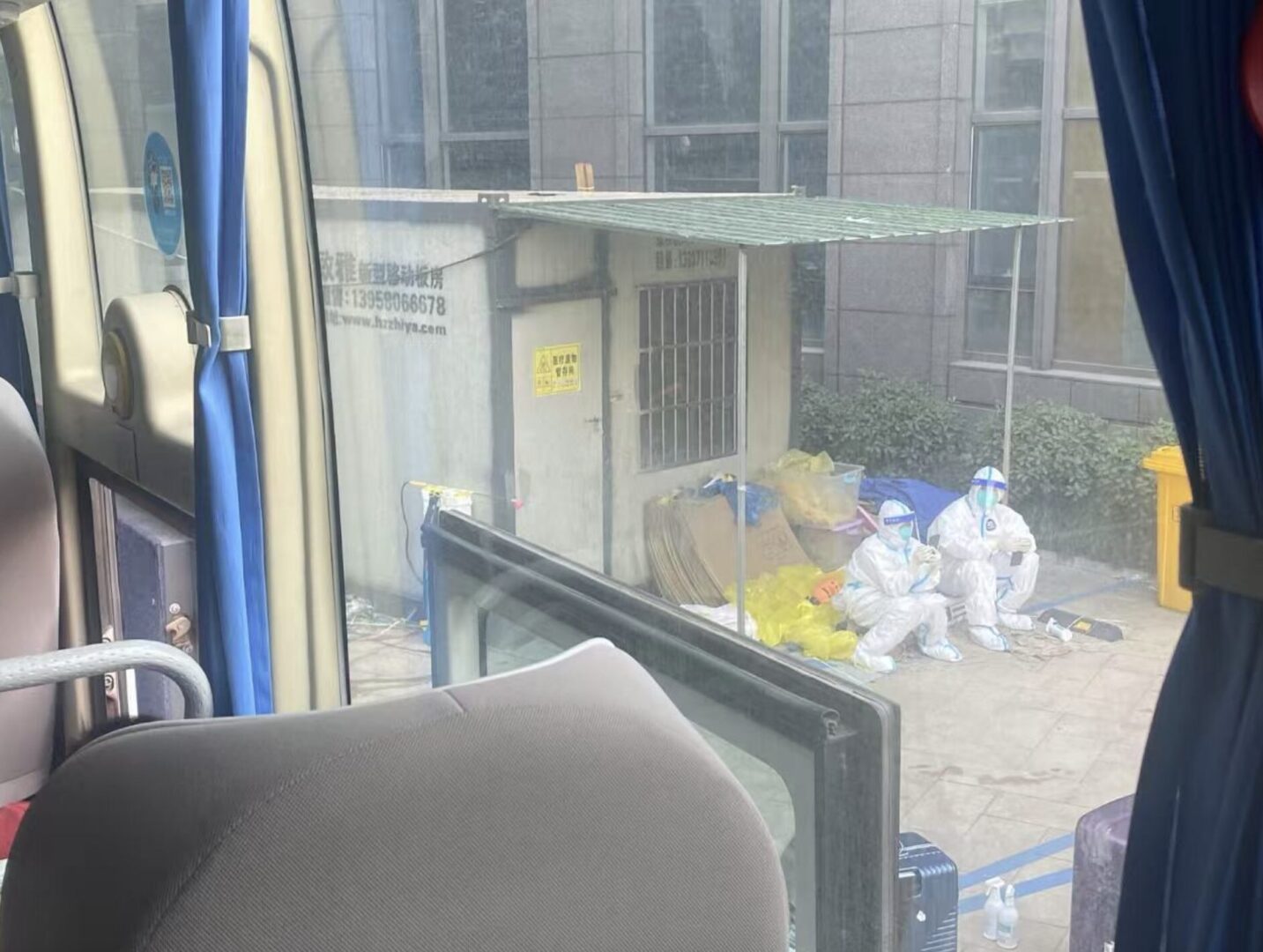
The bus to the quarantine hotel
Quarantine
Fourteen days minimum at the outset, up to twenty-one at some points, in a single room you were not permitted to leave.
Meals were left outside the door. Temperature was reported twice daily to a WeChat group. Swabs came at intervals, administered in the doorway. Windows opened, in the better hotels. And at the end, if all results were clear, several more days of health monitoring at home in your destination city — a different jurisdiction, with its own rules and often its own additional requirement.
The people who did this were rarely tourists. They were students, workers and families making a trip they’d deferred for a year or more, and the arithmetic was brutal: three weeks of a hotel room, both directions, for two weeks with your parents.
Why record it
Because the rules changed abruptly in late 2022 and it’s already becoming difficult to believe. Because a generation of Chinese families spent two or three years apart. And because the current ease of entry — visa-free for a lot of nationalities, a phone and a passport and you’re through — is worth appreciating rather than assuming.
If you were planning a trip during those years and gave up, this is your reminder to reschedule it.
- #china essentials
- #covid
- #travel history
- #quarantine