
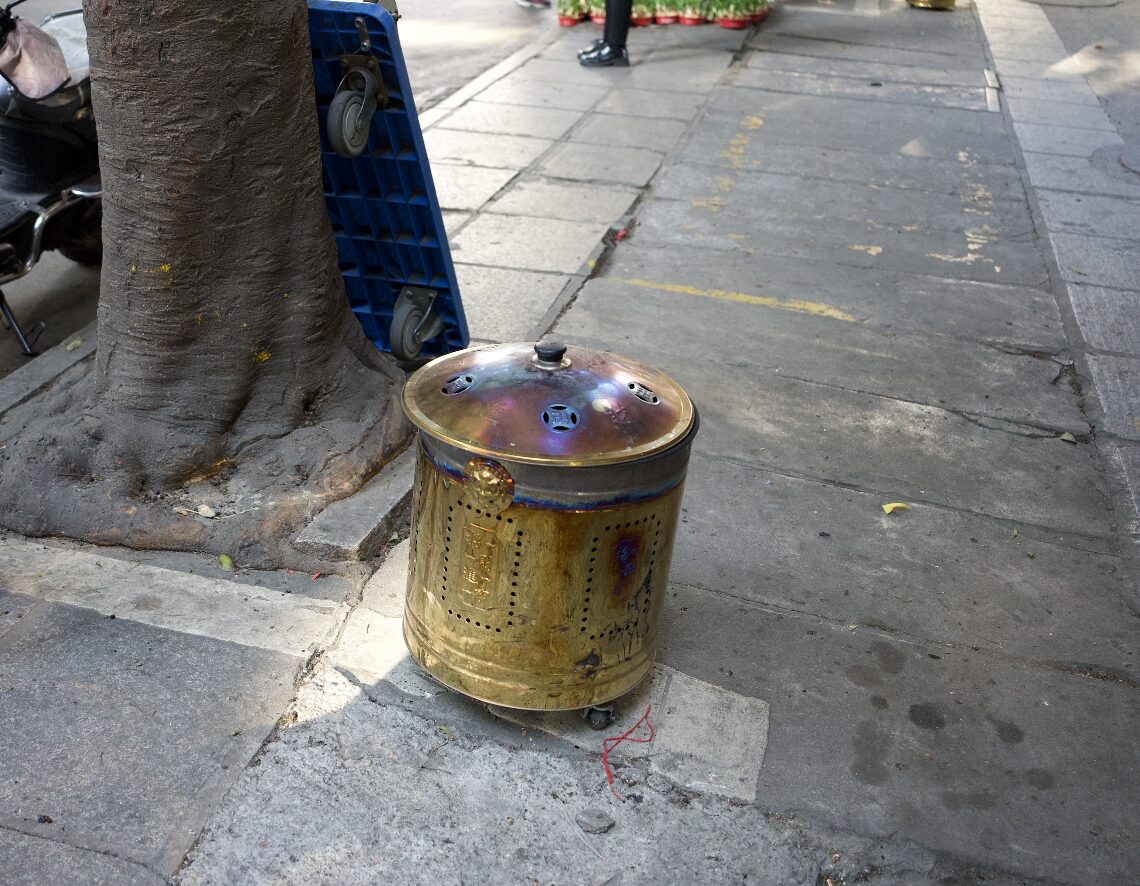
Every doorstep had a metal bucket in front of it, and every bucket was full of burning gold paper. Nobody had mentioned it. This is what Quanzhou's ritual calendar looks like when you happen to arrive on the right day.
We arrived in Quanzhou expecting a quiet day of temples, and walked into a city on fire.
Not literally — but close enough to stop you in the street. Outside almost every door was a metal bucket or brazier, and in every one of them, stacks of gold-leafed paper burning. The smoke sat in the lanes at head height. Families were crouched beside the fires feeding sheets in one at a time, unhurried, talking. Whole neighbourhoods, all at once, all afternoon.
What’s actually being burned
The paper is joss paper — jinzhi, gold paper, and its silver counterpart. It isn’t currency and it isn’t a symbol of one: burning it transfers it, converting a material offering into something usable by the dead and by the gods.
The gold goes to deities and to ancestors. The silver, generally, to spirits with no descendants to look after them. What you buy at the shop is stamped, foiled, sometimes folded into ingots, and the shops that sell it are as ordinary here as a newsagent.
Fujian — and Quanzhou above all — has one of the densest ritual calendars in China. Temple birthdays, ancestor days, and above all the seventh lunar month, when the neighbourhoods take turns hosting offerings for the wandering dead. On those days the burning is collective, street by street, and the smoke is inescapable.
What it feels like
Two things struck us and both are worth saying.
The first is how ordinary it was. Nobody was solemn. People chatted, checked phones, sent children in for more paper, poked the fires. It’s a household chore with a sacred function, and it’s performed the way you’d water plants.
The second is the scale of participation. This wasn’t a handful of older residents keeping something alive. It was everyone — young families, teenagers, shopkeepers stepping out between customers. In a country where a great deal of religious practice has thinned out, coastal Fujian is where it didn’t, and Quanzhou is the centre of it.
That continuity is directly connected to the city’s history as a port. The temples here funded voyages and received thanks for safe returns, the Mazu cult that spread across maritime Asia started on this coast, and the emigrant communities in Taiwan and Southeast Asia have kept the connection alive in both directions.
If you want to see it
Don’t plan it too precisely. The calendar is lunar and neighbourhood-specific, and the best encounters are accidental. But the seventh lunar month — roughly August — is the densest period, and any temple’s founding-day festival will produce something.
Ask at your guesthouse. They’ll know what’s happening this week and where, and they’ll tell you gladly.
Then be a good observer:
- Ask before photographing people at their own front door — this is a family act, in public, which isn’t the same as public property
- Don’t step between someone and their fire
- Don’t touch the paper or the offerings
- If you’re invited to feed a sheet in, do it
Where this fits
Quanzhou is worth days regardless — see our city guide for the mosques, the temples and the food. For the rural version of the same religious culture, with god statues carried through villages by dozens of men, see temple parades in remote Fujian and Putian at New Year.
- #fujian
- #quanzhou
- #ritual
- #ancestors
- #festival