
Wenquan means "hot spring," and the county is named accurately. Soak in a public pool at dusk with everyone else in town, then eat your way down the one main street.
Wenquan (温泉) means “hot spring,” and Chinese place names are rarely this literal. The county sits at the foot of the Tian Shan in northern Xinjiang, surrounded by grassland, with springs steaming out of the ground along the river and a county town that exists largely to sit in them.
The setting
Drive west from town and you’re in open pasture within minutes. Cross the mountains and you’re at the Kazakh frontier — but there’s no border crossing here, and the absence of one is why the place feels the way it does. No freight, no transit trade, no border-town churn. Just a quiet county at the end of a road.
The mix is Kazakh herders on the grassland, Han families running the shops and noodle houses, and everyone knowing everyone. In summer the pastures fill with yurts and horses, and a walk through the fields turns into an invitation with some regularity.
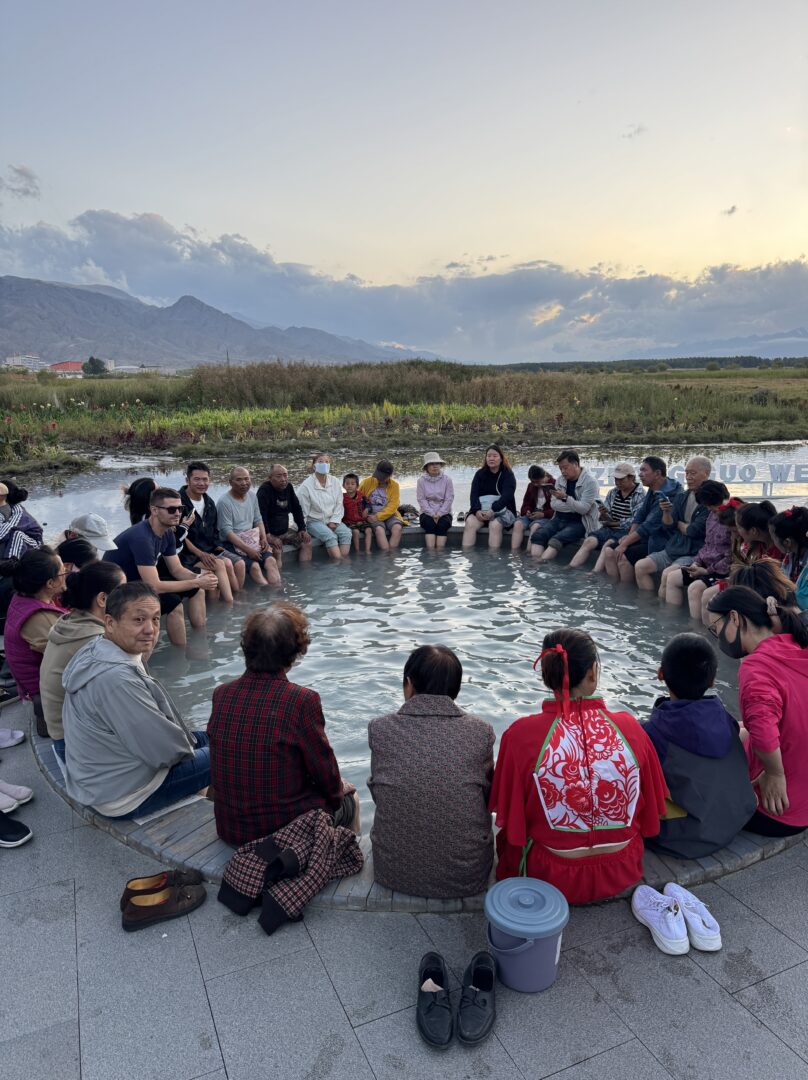
The public pools — the whole town turns up at dusk
The springs
Two ways to do it.
Hotels with spring water range from budget to fairly smart. At the cheaper end this means a tub in your room filled with heated spring water — pleasant, private, and not really the point. The better places have proper pool facilities.
The public pools are the experience. Go at sunset, when locals and travellers end up in the same water. The pools sit at different temperatures — the largest is the hottest — and there’s a faint sulphur smell that you stop noticing within a few minutes.
Bring grapes or something to pick at, get in, and watch the sun go behind the mountains. It costs almost nothing and it’s one of the better evenings available in northern Xinjiang.
Different pools, different temperatures — the big one is the hottest
Eating
Everything is on the main street; there’s no need for directions beyond that.
The summer afternoon market is the highlight. Vendors bring in whatever is ripe — Hami melon (哈密瓜), apricots (杏), pomegranates (石榴) — alongside Uyghur flatbread (馕) straight from the oven. Kazakh families sell dairy: yoghurt (酸奶), butter (黄油), and fermented mare’s milk (马奶子酒). Uyghur stalls sell ice cream, which in this climate sells itself.
Evening barbecue stalls do the classic Xinjiang combination: skewers (串儿) and naan, eaten standing up.
Breakfast is baked meat buns (烤包子), thin-skinned beef dumplings (牛肉包子) and a pot of milk tea (奶茶). Simple and very good — see our food guide for the wider context.
Practical notes
Where to sleep: hot-spring hotels at the top end, guesthouses in the middle and at the bottom. Book ahead in July and August.
When: summer. The pastures are green, the market runs, and the springs are pleasant rather than essential. Winter has the springs and not much else.
The reason to base here: Sayram Lake is a short drive from the north gate — and if you keep a hotel receipt of 180 yuan or more per room from a Wenquan hotel, entry through that gate has been free. Two nights here covers the lake, the springs and the market comfortably.
Nearby: Tacheng north along the border, the Ili valley south. More under Xinjiang.
- #xinjiang
- #wenquan
- #hot springs
- #kazakh
- #bortala