
There is one road between Dunhuang and Hami, it runs 400 kilometres through the Gobi, and there is no working fuel station on it. Here's what you need to know before you set out — and what waits on the other side.
Some border crossings are a formality. This one is a logistics problem.
The road from Dunhuang in Gansu to Hami in Xinjiang runs roughly 400 kilometres through open Gobi, and there is nothing on it. Not a hotel, not a shop, not a village. It is the only link between the two cities, which is the one reassuring thing about it — there’s steady traffic, so a breakdown means a wait rather than a crisis.
What to know before you go
Phone signal ends about 80 km out of Dunhuang and doesn’t come back for a long stretch. Download your maps.
There’s a police checkpoint at roughly the 160 km mark, with a small rest area attached. Passports out; the process is routine.
There is no working fuel station on the route. This is the detail that matters. Cars with a full tank are fine. On a motorbike, you need to carry enough extra fuel to cover 400 km with a margin — treat the whole crossing as a single leg with no resupply.
Wind and heat are the other variables. The Gobi here is gravel plain rather than dune, exposed in every direction, and crosswinds through the gaps get strong enough to be a real factor on two wheels. Summer surface temperatures are punishing. Carry more water than you think you’ll drink.
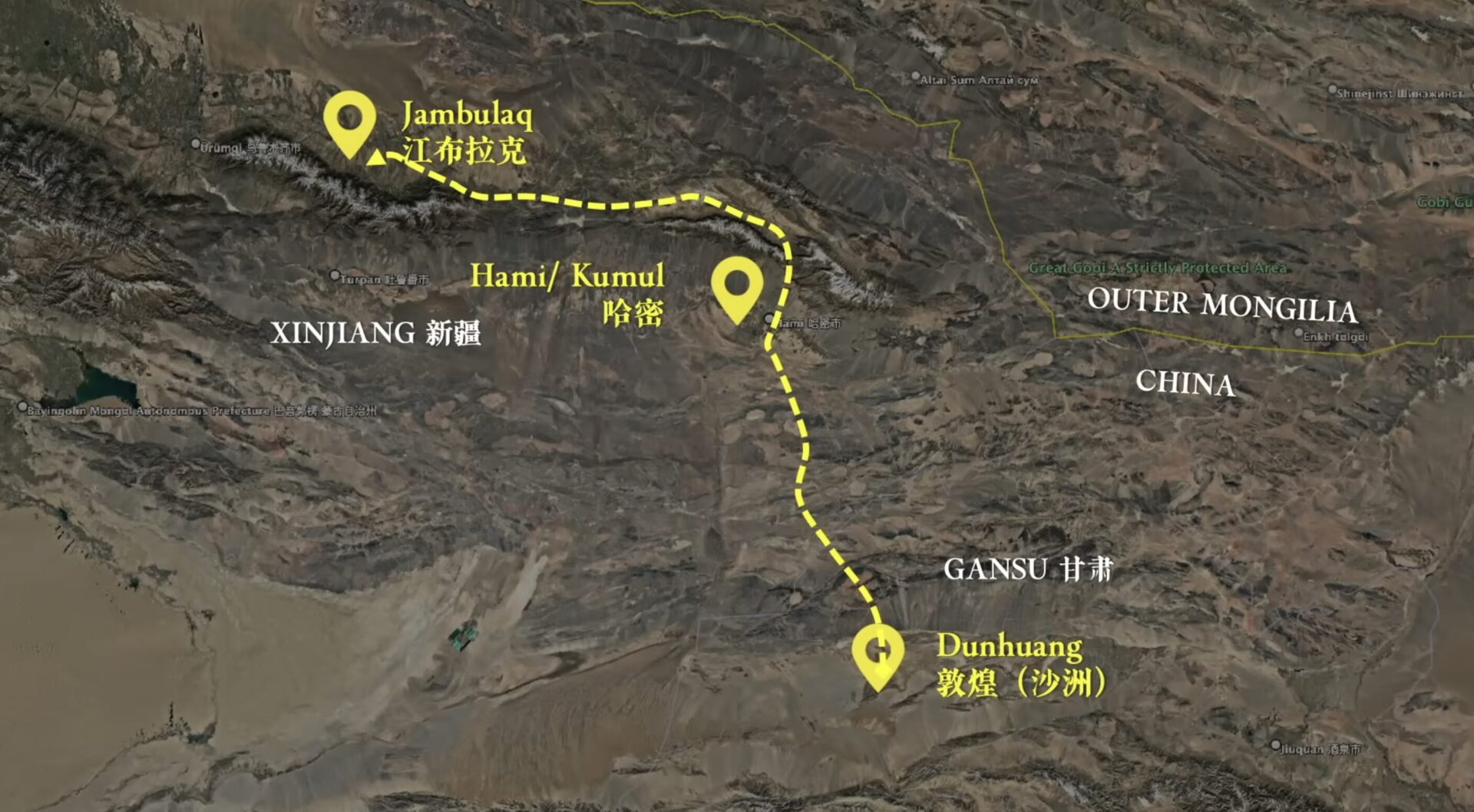
The route: Dunhuang → Hami → Jiangbulake
Hami, on the other side
Then it stops. Hami appears as green as anything you’ve seen in a week, and the Tian Shan stands on the northern horizon, closer than it has any right to be after so much flat ground.
Hami — Kumul in Uyghur — is an oasis town in eastern Xinjiang and has been a Silk Road stop for as long as there’s been a Silk Road. Marco Polo broke his journey here before the Taklamakan crossing to Kashgar, and what he wrote about was the melons.
They’re still the thing. Hami melon (哈密瓜, hāmìguā) — literally “honey melon” — is named after the place and, along with the melons of Guazhou just back across the Gansu border, has a national reputation. Eaten within a hundred kilometres of where it grew, it’s a different fruit from the one that reaches eastern China.
What to do
Aletun food street in the town itself is the best introduction to Xinjiang cooking you’ll get on a first evening: skewers over charcoal, nan from the oven wall, polo, hand-pulled noodles. Cheap, busy, and open late.
Barkol grassland (Balikun) sits north of the city in the Tian Shan, high enough to be green and cool while Hami bakes. It’s a day trip — negotiate a taxi for the round trip rather than trying to piece it together — and it’s the moment you realise Xinjiang isn’t all desert.
From here the road continues west and north into the mountains, toward the Kazakh summer pastures at Jiangbulake. That’s where the trip stops being about endurance and starts being about the good part.
- #xinjiang
- #gobi desert
- #road trip
- #hami
- #silk road