
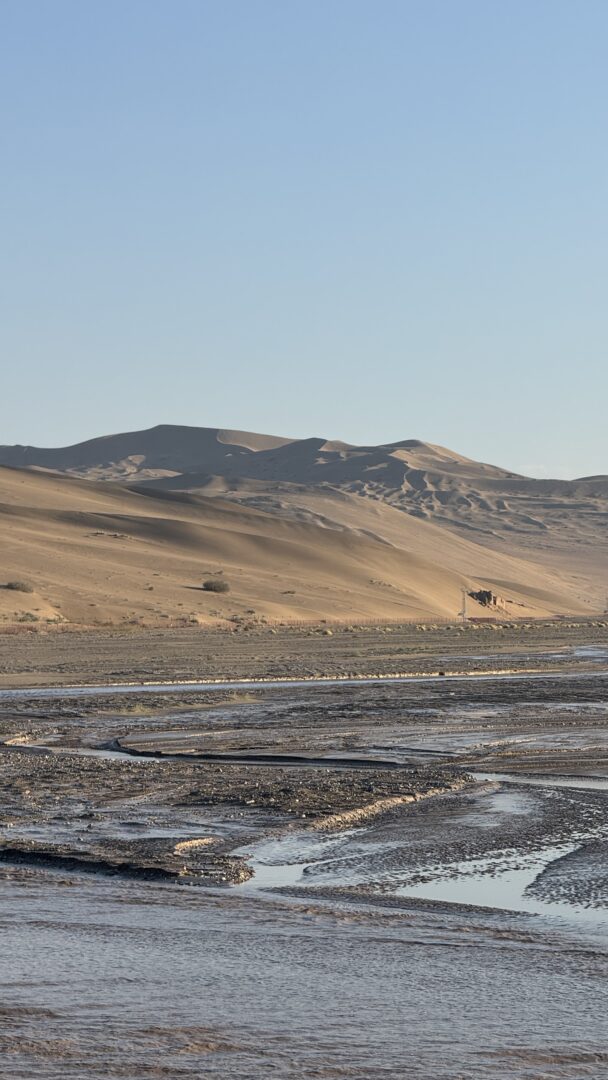
Sandy soil, ferocious sun and cold nights make Guazhou's melons the best in China. It's also the last green stop before the Gobi takes over on the road to Dunhuang.
Guazhou (瓜州) means “melon prefecture,” and the name is not marketing. The county has been growing melons on the Silk Road for something like a thousand years, and if you ask people in Gansu where the best ones come from, this is the answer you get.
Why the melons are good
It’s a combination of three things, none of them pleasant to live in.
Sandy, well-drained soil, which stresses the plant and concentrates the sugar. Intense solar radiation at 1,100 metres with almost no cloud. And a large diurnal temperature swing — hot days, genuinely cold nights — which slows respiration overnight so the fruit keeps the sugar it made during the day.
The same physics is why the grapes at Turpan and the melons of Hami are what they are. The whole Silk Road corridor is accidentally optimised for fruit.
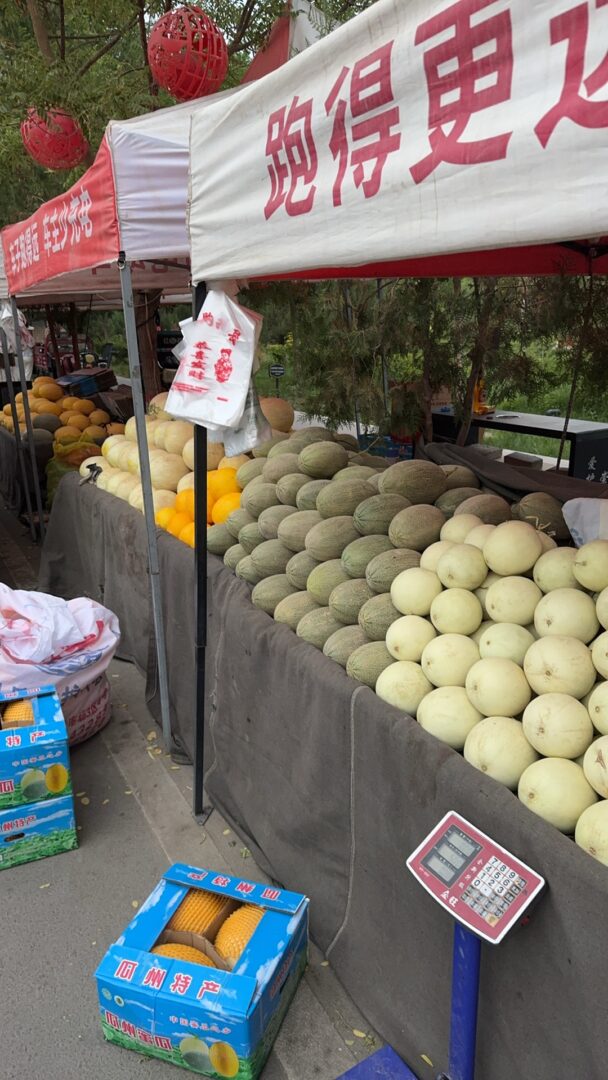
Eaten at the roadside within a few hours of cutting, a Guazhou melon is a different object from the one that reaches a supermarket in Shanghai. Buy a whole one, get the vendor to cut it, and eat it standing there.
In season, they’re stacked at every roadside
Riding through
The country here is the transition zone. Leaving Guazhou westward, irrigated fields and poplar shelterbelts give way to gravel plain, then to dune and rock outcrop, and the green stops in a line you can see.
That transition is exactly what made this a caravan route rather than a road. Merchants moved oasis to oasis, and the distance between water sources set the day’s stage. Guazhou was one of those stages — a place to rest, water animals, and restock with the one commodity that was both food and drink.
The county also holds the Yulin caves, a Buddhist grotto complex related to Mogao at Dunhuang and, in some individual caves, better preserved. Far fewer visitors, and worth the detour if the cave art has taken hold.
Onward to Dunhuang
Guazhou to Dunhuang is a couple of hours west, and it is the classic Silk Road approach: desert, distant mountains, and occasional wind farms — the corridor is one of the windiest inhabited parts of China and now generates power on an enormous scale.
Dunhuang is where the route split around the Taklamakan, and where the caves are.
Practical notes
Getting there: Guazhou is on the Lanzhou–Ürümqi high-speed line and on the G30 expressway. Most people pass through on the way to Dunhuang; stopping is a decision you make deliberately.
When: melon season is roughly July to September, which is the only real reason to time a visit. September is best — harvest, and the heat has broken.
Where to sleep: basic county-town hotels. Dunhuang has everything, and is close.
Continuing: west into Xinjiang means 400 km of Gobi with no fuel — read that before you set out.
- #gansu
- #guazhou
- #melons
- #silk road
- #gobi